
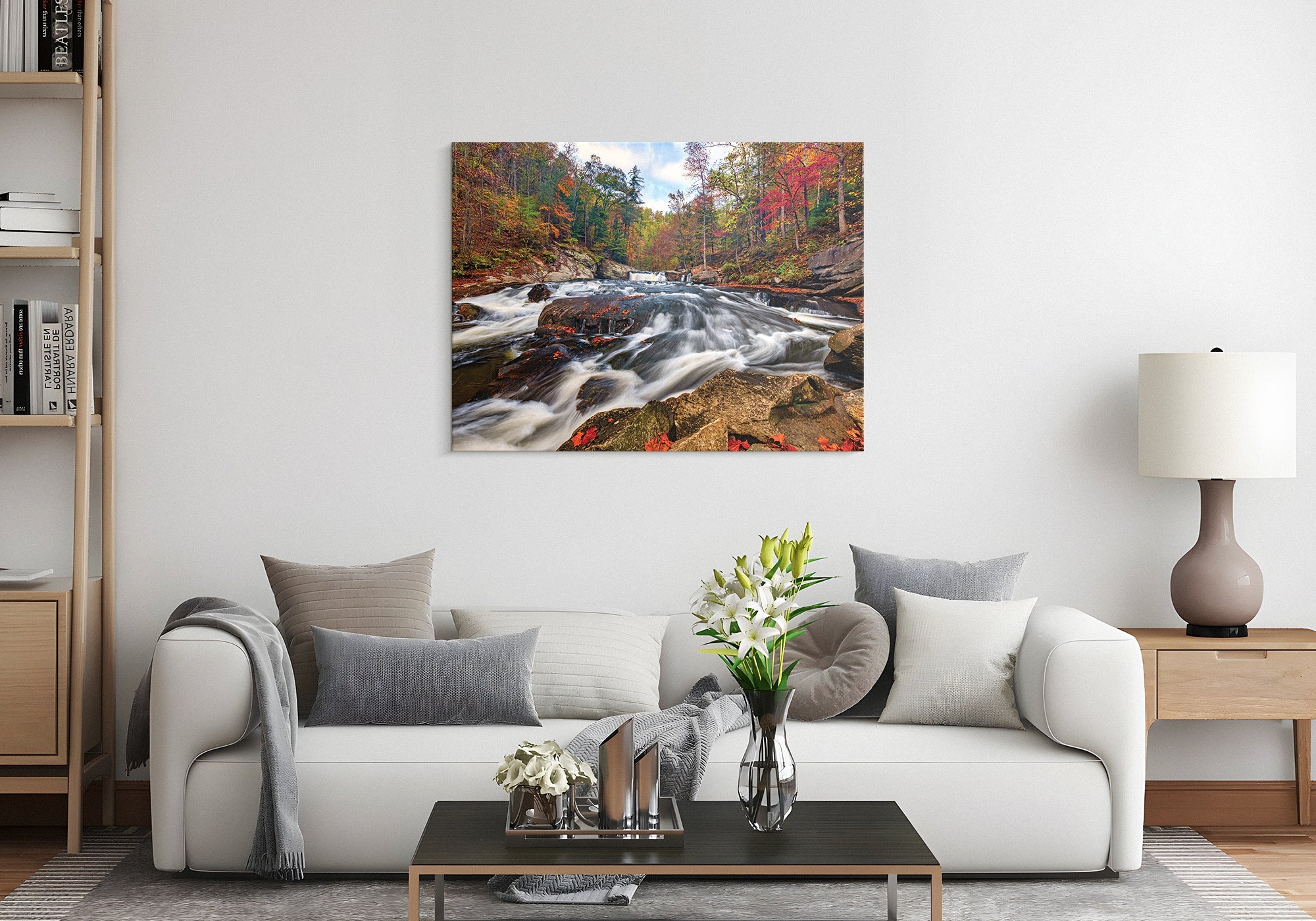
Family Memories Wall Art - Art That Holds a Feeling You Share
The best family memories wall art holds a feeling the whole household shares — a coast you keep going back to, a season that means something, a quiet scene that feels like home. In a family room, that shared feeling does more than a wall of personal photos ever can. Choose one or two evocative pieces everyone recognizes as “ours,” and the room starts to feel like it belongs to all of you.
There is a particular kind of art that makes a family room feel like a family room. Not the piece that impresses a guest, and not a wall crowded with framed photographs, but the one that quietly says: this is our place. It might be a seascape that reminds everyone of the same summer, a warm-lit field that feels like a slow Sunday, a dock at first light. Nobody in the room has to explain why they like it. They just do — together.
That shared recognition is what “family memories” art is really for. It is easy to assume the phrase means personal photos, and photos have their place. But the room your family actually lives in every day is not served by turning a wall into a scrapbook. It is served by one or two pieces that carry a feeling everyone in the house connects to — art that holds a memory without needing a caption.
Everything here is Designed in California and hand-made to order by Fine Art Canvas — making canvas art since 1989, with free 90-day returns and a 1-year warranty on every piece.

Family Memories at a Glance
- What it is really about: Shared feeling — art that evokes a place, season, or moment the whole family connects to
- Works best in: The family room, den, or any everyday shared space where the household actually spends time together
- The core decision: Art that holds a memory everyone recognizes vs. a wall of personal photos only some people are in
- What to look for: Evocative scenes — coastlines, open country, warm light, familiar places — with a mood the family already shares
- What to avoid: Crowding the wall with framed photographs; choosing a scene only one person feels anything about
Art That Holds a Feeling, Not a Photo
The mistake most people make with family memories art is a reasonable one: they hear “memories” and reach for photographs. Soon the wall is a grid of framed faces — and the room that was supposed to feel warm starts to feel busy. Photos are personal, but a wall full of them asks a lot of a shared space. They date quickly. They only mean something to the people in them. And they rarely hold together as a designed wall.
Evocative scene art does the emotional work differently. A seascape does not show your family — it shows the feeling of the trips you took together. A warm summer field does not picture a specific afternoon — it holds the mood of dozens of them. That is why a single well-chosen scene can carry more shared meaning than twenty photographs: it leaves room for everyone’s memory, instead of pinning down one.
A photograph answers “who was there?” An evocative scene answers “how did it feel to be there?” Both are memory. But in the room the whole family shares, the second question is the one that brings people together — because everyone can answer it, even the people who were not born yet.
How to Recognize a Piece That the Whole Family Shares
The test is simpler than it sounds. Stand in front of a piece and ask whether more than one person in the house would feel something looking at it — and whether they would feel roughly the same thing. Not the same taste, the same feeling. Belonging. Calm. The pull of a place you have all been.
Scenes tend to pass this test more easily than statements or graphics, because a landscape does not tell you what to think. It gives you room to bring your own memory to it. A coastline means the lake house to one person and a honeymoon to another, and both are right. That openness is exactly what makes a scene feel shared rather than assigned.
When you are choosing for a shared room, pick the piece your family would still love if you could not explain why. The scenes that hold up over years are almost never the cleverest ones — they are the ones that feel like home the moment you see them, to more than one person at once.
When Family Memories Art Is the Right Direction
This approach fits the family room and den better than almost anywhere else in the house, precisely because those rooms are lived in together. The feeling you are after is warmth and belonging — not the polish of a formal living room, and not one person’s identity stamped on the walls. It is the register of a room where the whole household is comfortable being themselves.
✓ Works Well When
- The room is shared every day — a family room, den, or the space everyone gravitates to
- You want the room to feel warm and personal without becoming a photo gallery
- There is a place, season, or landscape your household genuinely shares a feeling about
- You would rather one or two meaningful pieces than a wall you have to keep updating
- You want art that welcomes everyone in the family, not art that reflects a single taste
✗ Consider Something Else If
- You want the room to make a bolder visual statement — Bold Statements is built for that
- You are after clean, contemporary polish over sentiment — see Modern Chic
- The room’s main job is hosting and easy hangouts — Cozy Entertainment sets that tone; for warmth through texture and natural tone, see Rustic Warmth
Five Moves That Work
The practical decisions that turn a sentimental idea into a family room wall that actually feels shared.
1. Choose the feeling before the subject
Start with the mood you want the room to hold — calm, warmth, the pull of a favorite place — and let that guide the subject, rather than the other way around. A family room does not need the “right” landscape. It needs the one that makes more than one person in the house exhale a little when they walk in.
2. Let one piece carry the wall
Resist the urge to fill the space. In a shared room, a single generous piece reads as calm and considered, where a crowded wall reads as busy. One evocative scene above the sofa does more for the feeling of the room than a scatter of smaller frames. If you want more than one, keep them related — the same palette, the same kind of place.
3. Size it to the room’s main wall, not to the memory
The emotional weight of a piece does not change its physical scale. Over a sofa or the family room’s main wall, art should span roughly two-thirds to three-quarters of the furniture width, centered about 57 to 60 inches from the floor. A meaningful piece hung too small still reads as an afterthought. See the Wall Art Size Guide for full sizing by wall and furniture.
4. Keep photos for shelves, and scenes for the wall
This is not a rule against photographs — it is a division of labor. Personal photos belong where you can change them easily and view them up close: a shelf, a console, a stair wall. The family room’s main wall is where an evocative scene can hold the whole room’s mood without dating or cluttering. Give each the job it does best.
5. Pick a palette the room already lives in
A shared room usually already has a temperature — warm neutrals, soft blues, natural wood. Choose a scene whose colors settle into that rather than fighting it. Family memories art should feel like it has always been there, which means it should look at home with the couch everyone actually sits on.
Six Pieces That Hold a Shared Feeling
Every piece below is hand-made to order from the Family Memories collection — evocative scenes chosen for the mood they hold rather than the subject they name. Each is available as gallery-wrapped canvas, framed canvas, or framed print, with pricing live at each product page.


Common Mistakes and the Fix
A grid of framed family photos feels meaningful in theory and busy in practice — and it only means something to the people pictured. Fix: keep personal photos on shelves and secondary walls, and give the family room’s main wall to one evocative scene the whole household connects to. Let the wall hold a feeling everyone shares, not faces only some recognize.
A family room is shared, so art chosen for one person’s taste quietly signals whose room it really is. Fix: choose a piece more than one person in the house feels something about. The test is not agreement on style — it is a shared feeling. If two people would call it “ours,” it belongs in the room.
Sentiment does not scale a canvas. A cherished scene hung small over a large sofa still reads as an afterthought. Fix: size to the wall — roughly two-thirds to three-quarters of the furniture width — so the piece carries the weight its meaning deserves.
A scene chosen to look current can feel like a stranger in a room the family has lived in for years. Fix: choose colors and mood the room already lives in. Family memories art should look as though it has always belonged there — because the point is belonging, not novelty.
Find the Piece That Feels Like Home
Browse the full Family Memories collection — hand-made to order, Designed in California, with free 90-day returns on every piece.
Shop Family Memories Wall ArtFrequently Asked Questions
What is family memories wall art?
Family memories wall art is art that holds a feeling a household shares — a coastline, a season, a familiar landscape that everyone connects to — rather than a literal photograph of the family. In a family room, this evocative approach tends to work better than a wall of personal photos: a single meaningful scene carries shared mood without dating or crowding the space, and leaves room for everyone to bring their own memory to it.
Should family room wall art be personal photos?
Photos have a place, but the family room’s main wall usually is not it. A grid of framed photographs reads as busy in a shared space and only means something to the people pictured. A better approach is to keep personal photos on shelves and secondary walls, and give the main wall to one evocative scene the whole household feels something about. That way the room holds a shared feeling rather than a private archive.
How do I choose wall art the whole family will like?
Aim for shared feeling, not shared taste. Stand in front of a piece and ask whether more than one person in the house would feel something looking at it — belonging, calm, the pull of a place you have all been. Evocative scenes pass this test more easily than statements or graphics, because a landscape gives everyone room to bring their own memory to it instead of assigning one meaning.
What kind of art works best in a family room or den?
Art that feels warm and shared rather than formal or personal to one person. Evocative scenes — coastlines, open country, warm light, familiar places — suit the everyday register of a room the whole household lives in. The goal is a piece that welcomes everyone and looks at home with the furniture the family actually uses, not one that impresses a guest or stamps one person’s identity on the walls.
What size should family room wall art be?
Size to the wall, not to the sentiment. Over a sofa or the family room’s main wall, art should span roughly two-thirds to three-quarters of the furniture width, centered about 57 to 60 inches from the floor. A meaningful piece hung too small still reads as an afterthought. For complete guidance by wall type and furniture, see the Wall Art Size Guide.
How many pieces should I hang in a family room?
Usually one, sometimes a related pair. In a shared room, a single generous piece reads as calm and considered, where a crowded wall reads as busy. If you want more than one, keep them related — the same palette or the same kind of place — so they hold together as one designed wall rather than competing for attention.
Family memories art is not the photo you frame — it is the feeling you share. Choose the scene more than one person would call “ours,” and the room starts to belong to everyone in it.


Leave a comment
This site is protected by hCaptcha and the hCaptcha Privacy Policy and Terms of Service apply.