
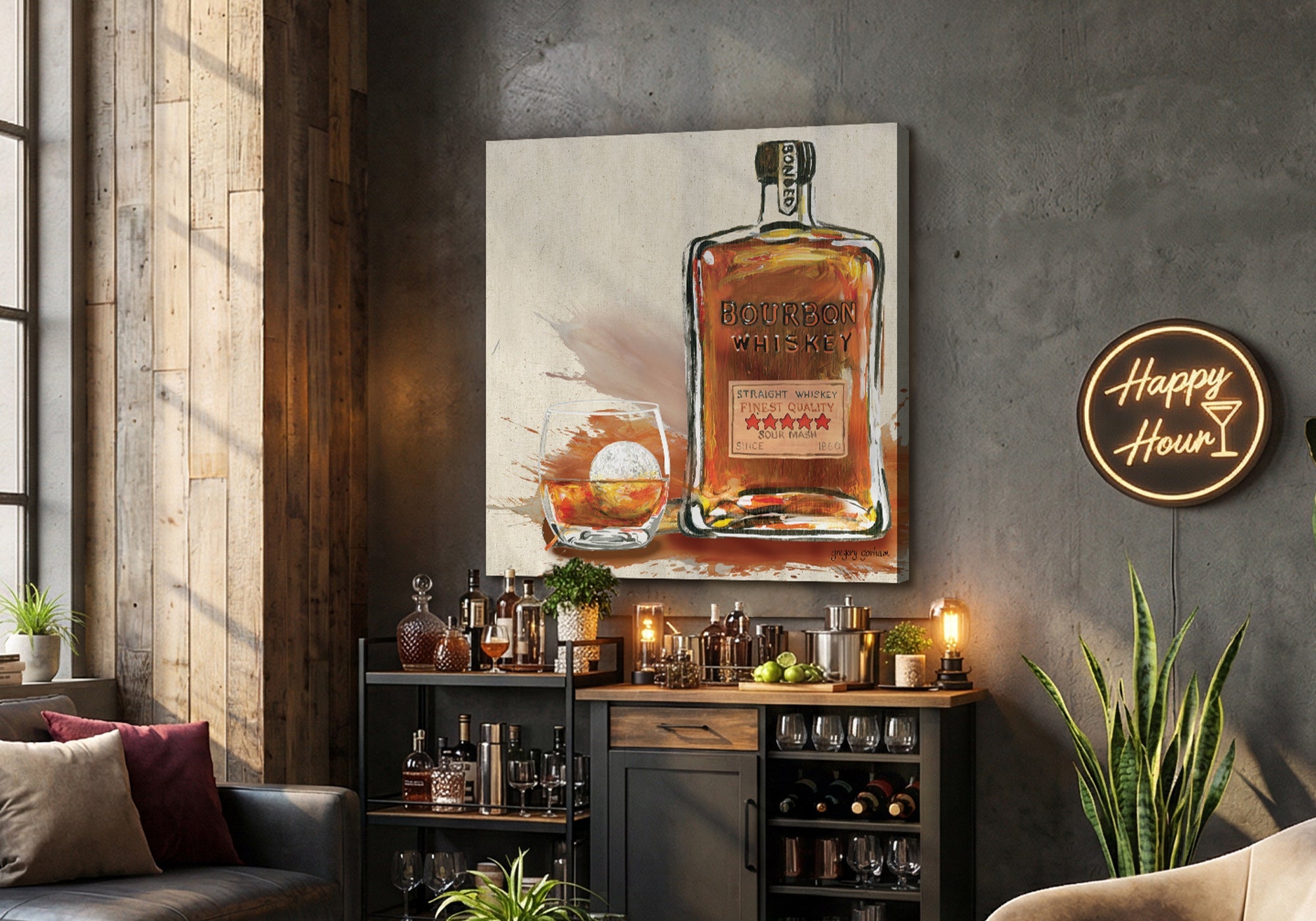
Bar and Lounge Wall Art for Man Caves: How to Build a Cocktail Lounge, Not a Basement Corner
Bar & Lounge Wall Art
The short answer: You don't want a bar. You want how a great bar makes you feel. A room that captures that feeling isn't built with beer signs and brand logos — it's built around one well-chosen piece that sets the tone for the whole space. The distinction between a great home bar and a basement corner with a mini-fridge is almost entirely in the art.
In This Guide

Two home bars. Both have the same equipment — a good cabinet, decent glassware, the bottles you actually use.
The first has a neon Budweiser sign, a “Beer O’Clock” print, three branded mirrors from different breweries, and a chalkboard menu copied from a bar downtown. It looks like a bar. It specifically looks like someone’s idea of what a bar looks like.
The second has one piece above the bottles: a large canvas print of Hopper’s Nighthawks. Late night, diner counter, two figures in the city glow. Nothing about it says “bar.” Everything about it creates the feeling of one.
The difference isn’t budget. It’s understanding what you’re actually trying to create.
Cocktail Lounge vs. Basement Corner: What Makes the Difference
A commercial bar decorates around the brand — neon signs, labeled mirrors, merchandise from the distributors. It’s advertising dressed as atmosphere. It works in a commercial space because the customer’s expectations are already set and the goal is reinforcement, not surprise.
A home bar doesn’t need to advertise anything. Its only job is to create a feeling. When the art decorates around the concept of a bar rather than around the feeling you want the room to have, it produces a space that reads as imitation rather than intention.
Decorating around the idea of a bar — with signs, logos, brand memorabilia, and novelty prints — signals that the room is performing “bar” rather than being one. Great cocktail lounges and jazz bars don’t advertise what they are. The atmosphere is created by the quality of what’s in the room, not by signs announcing the theme.
The test is straightforward: would this piece exist in the room you’re trying to evoke, or would it exist in a spirit-brand marketing campaign? Nighthawks would hang in a jazz bar. A “Drink More Beer” sign would hang in a chain restaurant’s restroom. The difference is obvious when you look at each piece through that lens.
Three Approaches to Bar and Lounge Wall Art
The best home bars don’t all look alike. They work from different aesthetics, different eras, different emotional registers. What they share is that the art creates the atmosphere rather than announcing it. Here are the three approaches that work consistently:
Classic — Art That Belongs in the Room You’re Evoking
The most reliable approach: choose a piece that would genuinely hang in the kind of bar you’re trying to create. Not a piece about bars or drinking — a piece that carries the atmosphere you’re after.
Hopper’s Nighthawks is the most famous example because it works so well. It’s a painting about solitude, late-night city light, and the particular intimacy of a counter and a few people — which is exactly what a great bar at its best feels like. It doesn’t say “bar.” It creates the feeling of one.
The same logic applies across cocktail aesthetics: a sophisticated jazz-era print, a moody cityscape at night, a still-life with well-made things. Art that evokes the world the bar belongs to rather than art that announces the bar’s existence.
Cocktail — The Drink as Subject
Cocktail-specific art works when it’s chosen for its visual quality rather than its subject matter. The difference is between a piece that happens to depict a martini and a piece that depicts a martini in a way that makes you want one.
The best cocktail art has a point of view — a graphic confidence, a palette that enhances the room, a level of craft that matches the quality of what’s being served below it. It’s the visual equivalent of using good glassware: it says something about the care taken with the whole experience.
What doesn’t work: generic stock-photo cocktail prints, novelty “bartender rules” typography, or decorative pieces that treat drinking as a joke. Those read as college apartment, regardless of age.
Lounge — Jazz, Music, and the Culture of the Bar
The culture that built great bars — jazz, blues, the late-night world of musicians and artists — translates directly into bar wall art because it carries the same atmosphere. A jazz cat portrait above a well-stocked bar says “this is a room with a certain kind of soul” without spelling it out.
This approach works particularly well when the bar has a music component — a good speaker system, a record player, any emphasis on listening. The art reinforces the intention without competing with it.
Classic and lounge work together naturally — Hopper’s quiet city light and a jazz cat portrait share an emotional register even if they’re technically different subjects. What doesn’t combine easily is classic/lounge with novelty bar signage: the tonal gap between Nighthawks and a “Life Is Too Short to Drink Bad Wine” sign is large enough to undermine both pieces.
Three Questions Before You Browse
Before You Browse Bar and Lounge Art
- What feeling are you trying to create? Late-night city sophistication? A warm, jazz-era lounge? A clean, contemporary cocktail bar? The feeling determines which approach and which specific pieces will work. Name the feeling before you start browsing.
- What’s above the bar? The wall directly above the bottles and glassware is the most important surface in a home bar. One excellent piece here sets the whole room’s tone. Start here before decorating anywhere else.
- Does this piece belong in the room I’m evoking, or is it about that room? Art that belongs in the atmosphere creates it. Art that’s about the atmosphere announces it. If you’re unsure which category a piece falls into, it’s usually the second one.
Featured Bar and Lounge Art
These are among the strongest-selling pieces in the Bar & Lounge collection — each one chosen to create atmosphere rather than announce a theme.


Every piece is handcrafted to order — Designed in California. Hand-made to order. We’ve been making canvas art since 1989, with free 90-day returns and a 1-year warranty on every piece.
Size Guide for Bar Wall Art
The wall above the bar is usually the most important surface in a home bar — and the one most worth getting right. One well-scaled piece here does more for the room than three smaller pieces scattered around it.
| Wall / Zone | Recommended Size | Why |
|---|---|---|
| Above the bar (primary surface) | 30–48 inches wide | Wide enough to anchor the zone; scale to roughly two-thirds of the bar width |
| Feature wall behind bar seating | 40–60 inches wide | The piece people face while seated — needs to hold attention at conversational distance |
| Corner or secondary wall | 20–30 inches wide | Supporting piece — reinforces the atmosphere without competing with the primary focal piece |
| Narrow bar alcove or galley | 16–24 inches wide (vertical format) | Portrait orientation works better in tight spaces than landscape; gives the wall definition without crowding |
Leave breathing room above and below the anchor piece. The art should feel like it belongs above the bar, not like it’s trying to fill the space. For room-specific sizing guidance, see the Wall Art Size Guide.
Frequently Asked Questions
What wall art looks best above a home bar?
One well-chosen piece that creates the atmosphere you want, scaled to roughly two-thirds of the bar’s width. The best bar wall art doesn’t announce that it’s a bar — it creates the feeling of being in one. A moody city scene, a sophisticated cocktail print, or a jazz portrait will do more for a home bar than a collection of branded signs and novelty prints.
How do I make my home bar look like a real cocktail lounge?
Choose art that belongs in the room you’re trying to evoke, not art that announces the room’s theme. A great cocktail lounge doesn’t need signs telling you it’s a bar — the atmosphere does that. Start with one strong piece above the bottles, leave space around it, and let it set the tone before adding anything else. Quality over quantity: two excellent pieces in a well-considered arrangement read as more sophisticated than ten pieces covering every surface.
Is Nighthawks a good choice for a home bar?
One of the best. It creates the feeling of a late-night, city-lit space without being about bars or drinking at all. The image carries intimacy, quiet sophistication, and the particular atmosphere of a counter and a few people at the end of the evening — which is exactly what a well-designed home bar is trying to create. It works at any size but especially well at 36 inches or wider above a bar.
Should I use neon signs or bar art in my home bar?
Neon signs can work as a single accent — one sign, with purpose — but they become a problem when they’re the primary decorating strategy. A wall of neon brewery signs reads as a commercial space or a college apartment, not a personal lounge. If you want neon, treat it the way you’d treat a single bold piece of art: one, positioned deliberately, with clean walls around it.
What size art should I hang above a home bar?
Scale to roughly two-thirds of your bar’s width. If the bar is 48 inches wide, a 30–36 inch piece above it looks proportional. If you have a wider bar or a dedicated bar wall, scale up accordingly — 40 to 48 inches. One correctly-scaled anchor piece reads as more sophisticated than multiple smaller pieces covering the same wall. Leave breathing room above and below the piece — the negative space is part of what makes it feel deliberate.
Find the piece that sets your bar’s tone. Every canvas is handcrafted to order — Designed in California. Hand-made to order.
Shop Bar & Lounge Art


Leave a comment
This site is protected by hCaptcha and the hCaptcha Privacy Policy and Terms of Service apply.