
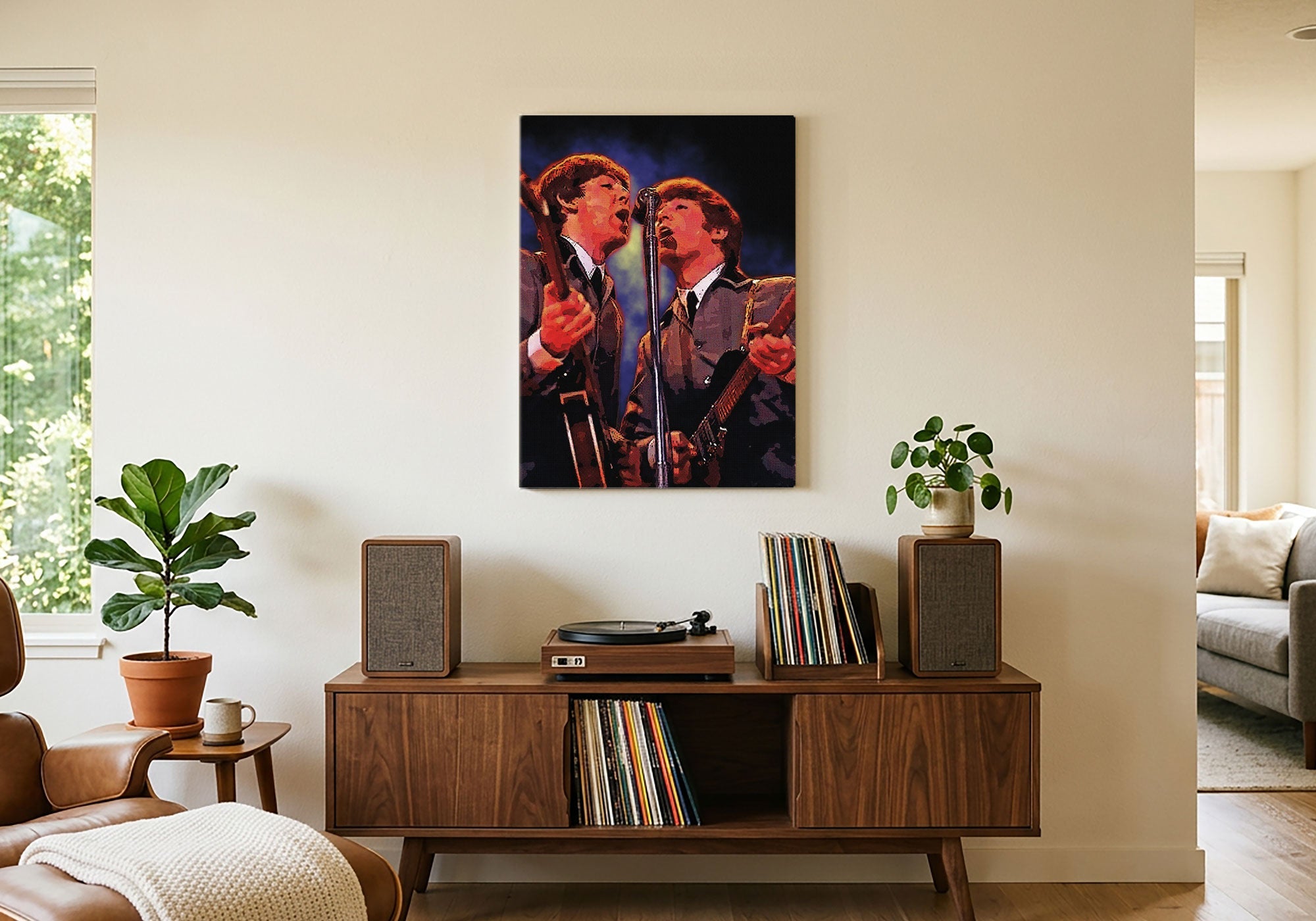
Music Icons Wall Art for Man Caves: How to Build a Listening Lounge, Not a Poster Shop
Music Icons Wall Art
The short answer: Music wall art turns a man cave into a listening lounge when it commits to one genre, one era, or one artist — not everything you've ever loved. A room that says jazz says something. A room that says jazz, metal, hip-hop, and classic rock says nothing. Pick a lane, build around it, and the art does the rest.
In This Guide

Picture two man caves, same square footage, same budget.
In the first room, Miles Davis's Kind of Blue cover hangs above a leather armchair. On the adjacent wall, a large-format print of a lone trumpet player in silhouette, backlit in amber. The shelves hold vinyl. The whole room says: sit down, put a record on, stay a while.
In the second room, the Beatles share a wall with Metallica. Sinatra hangs next to a hip-hop graffiti print. There's a vintage radio poster, a guitar-shaped clock, and a neon sign that reads MUSIC IS LIFE. Everything in the room loves music. Nothing in the room has a point of view.
Both owners care deeply about music. One room shows it. One room announces it.
The difference isn't budget or taste — it's focus. This guide will help you find yours.
The Listening Lounge vs. the Poster Shop
Here's the pattern that separates rooms that work from rooms that don't: the listening lounge has a perspective. The poster shop has a collection.
A listening lounge commits to something. Jazz from the 1950s. Classic rock from the arena era. Hip-hop's golden age. The art, the color palette, the furniture — everything reinforces a single feeling. Visitors don't need to be told what kind of room it is. They feel it the moment they walk in.
A poster shop represents everything its owner loves. Every band, every era, every genre gets a wall. The result is a room that accurately reflects a music library but doesn't create an atmosphere. It's a catalog, not a space.
The listening lounge isn't more expensive or more sophisticated. It just made a decision the poster shop avoided: it chose what to leave out. That's the only decorating decision you need to make. Everything else follows from it.
Three Ways to Build a Listening Lounge
Most rooms that work do it one of three ways. Each starts with a different kind of commitment.
Commit to a Genre
Genre is the most common anchor — and the most powerful, because genre carries its own visual language.
Jazz has a specific aesthetic: late-night clubs, abstract expressionism, album cover photography from the Blue Note era. A jazz room doesn't need to announce itself. The imagery does it automatically.
Rock has a different visual vocabulary: concert photography, hand-lettered tour posters, monochrome drama. Country has wide-open landscapes, vintage signage, weathered textures. Hip-hop has bold color, graphic design, street photography.
When you commit to a genre, you're not just choosing a music style — you're choosing a visual world. The art, the textures, the colors all reinforce each other naturally, because the genre already has established aesthetics you can borrow from.
The key discipline: one genre per room. Not “jazz and blues” (too broad). Not “jazz and rock” (contradictory). Jazz. Blues. Rock. Hip-hop. Pick the one that matters most, and let the others live in your playlist instead of on your walls.
Commit to an Era
Era-based rooms work especially well when your taste spans multiple genres but centers on a specific decade.
The 1970s had a distinct visual identity across every genre — rock, soul, funk, country. A 1970s music room can include multiple artists and styles without losing coherence, because the decade itself provides the unifying visual language: warm earth tones, specific typography, a particular quality of photography.
The same logic applies to the 1950s (jazz, early rock and roll, crooners), the 1980s (arena rock, new wave, hip-hop's earliest years), or the 1990s (grunge, alternative, gangsta rap).
Era-based rooms give you more flexibility in subject matter while maintaining visual coherence. The constraint isn't genre — it's time period. And time period carries enough visual weight to hold a room together.
Commit to Music in Context
The third approach is less about what music you love and more about what music does — the social and emotional context around it.
Some rooms are built around the experience of live performance: the energy of a concert, the intimacy of a small venue, the scale of a stadium. The art shows musicians playing, crowds listening, moments happening.
Other rooms are built around the ritual of listening: the careful act of choosing a record, setting a needle, sitting with headphones. This approach tends toward quieter, more intimate imagery — album art, studio photography, solitary musicians.
Context-based rooms often work across genres and eras, because they're unified by feeling rather than subject matter. A jazz club photograph and a rock concert print can share a wall if they're both capturing the same kind of energy — the electricity of a live performance, the communion between artist and audience.
Commit to a genre if you have one style that defines you — jazz people know they're jazz people. Commit to an era if your taste is broad but decade-specific. Commit to music in context if what you love is the experience of music more than any particular style. All three produce a listening lounge. The poster shop happens when you skip the commitment entirely.
Three Questions Before You Browse
Before You Browse Music Icons Art
- What's your commitment? One genre, one era, or one kind of musical experience. Not a list of everything you listen to — the one anchor that will hold the room together.
- What's the visual language? Every genre and era carries its own palette, its own quality of imagery, its own feeling. Name that feeling before you start selecting pieces — it's what lets different subjects coexist without competing.
- What's the anchor piece? The primary wall needs one strong image that establishes the room's point of view. Everything else is supporting art once you've found the piece that does that job.
Featured Music Icons Art
These are among the strongest-selling pieces in the Music Icons collection — each chosen to anchor a zone, not just fill a wall. Mac Miller shows how an artist portrait can read as art rather than memorabilia. Jazz Cats Quartet evokes a genre without depicting any particular musician. The Old Guitarist treats music as emotional experience rather than performance. Thanks for the Melodies captures the ritual of listening itself.


Every piece is handcrafted to order — Designed in California. Hand-made to order. We've been making canvas art since 1989, with free 90-day returns and a 1-year warranty on every piece.
Size Guide for Music Wall Art
Size affects how a piece reads in the room — whether it anchors the space or supports it. For music rooms, the anchor piece should do most of the work. The anchor piece should feel slightly larger than comfortable — music art that works tends to fill the space it claims rather than float in it.
| Canvas Size | Best Use | Typical Wall |
|---|---|---|
| 8×10 or 11×14 | Supporting pieces, vinyl shelf displays, tighter groupings | Narrow walls, beside shelving, gallery-wall filler |
| 16×20 or 18×24 | Mid-weight anchor, small rooms, single-piece statements | Above a console, between windows, end-wall accent |
| 24×36 | Strong room anchor, creates focal point | Primary wall behind seating, above a bar or record cabinet |
| 36×48 or larger | Dominant statement piece — one per room | Full feature wall, requires clear sightlines |
For room-specific sizing guidance, see the Wall Art Size Guide.
Frequently Asked Questions
Can I mix multiple music genres in one room?
You can — but each genre you add makes it harder to create atmosphere. One genre creates a room with a point of view. Two genres creates tension that requires careful curation to resolve. Three or more tends to produce the poster shop effect. If you love multiple genres equally, choose era instead of genre as your anchor — the decade will hold the room together across different styles.
Is it okay to put a musician portrait on the wall?
Absolutely — the question is which kind. Portraits that work in a room tend to be artistic interpretations rather than photographs or concert posters. They capture something essential about the artist rather than documenting a specific moment. A painted portrait of a musician reads as art. A printed photograph from a tour tends to read as memorabilia. Both have their place, but they create different kinds of rooms.
How many pieces of music art should a man cave have?
Start with one strong anchor piece and see what the room needs. Most rooms that end up over-decorated started with the intention to “add a few pieces” without establishing the anchor first. Get the main wall right, live with it for a few weeks, then decide whether supporting pieces add to the atmosphere or just fill space. Less is almost always better than more when music art is involved — the goal is atmosphere, and atmosphere doesn't require density.
What's the difference between music art and music memorabilia?
Memorabilia documents: signed posters, concert tickets, tour programs, backstage passes. It's meaningful to the person who was there. Art creates atmosphere for everyone in the room, not just the collector. The best music rooms often include both — but they keep them separate. Memorabilia works in a display case or dedicated corner. Art works on the primary walls. Mixing the two in the same visual field creates confusion about what kind of room it is.
Should music art match the room's color palette?
It should belong in the room, not necessarily match it exactly. The distinction matters: a piece that perfectly matches your wall color will disappear into it. A piece that shares one or two colors with the room but adds something unexpected will anchor it. Pick art for its atmospheric contribution first, then check whether the colors are compatible. If a piece creates the right feeling but the colors are slightly off, lean toward the feeling — color can be adjusted, atmosphere is harder to engineer.
Find the piece that sets the tone. Every canvas is handcrafted to order — Designed in California. Hand-made to order.
Shop Music Icons Art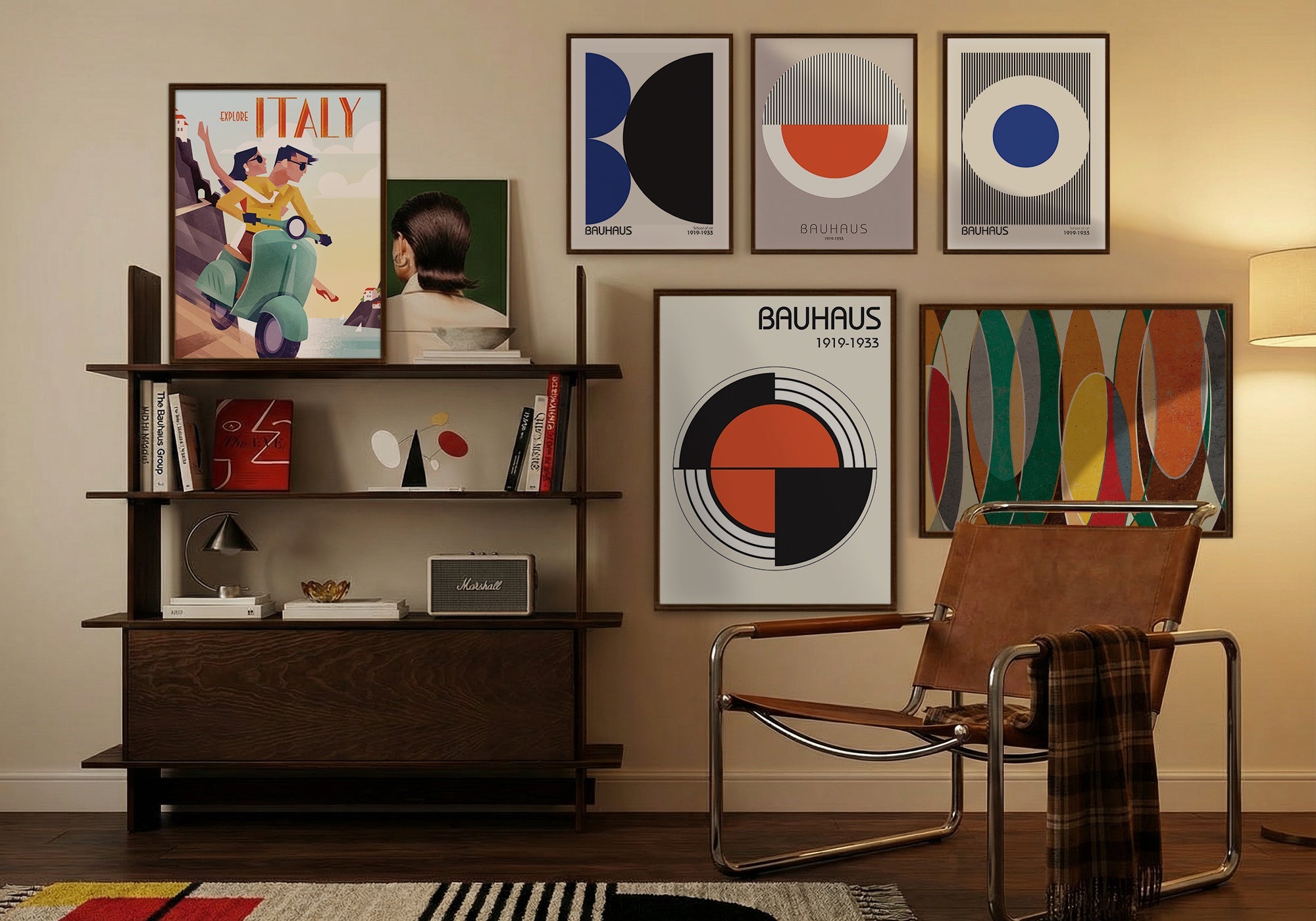


Leave a comment
This site is protected by hCaptcha and the hCaptcha Privacy Policy and Terms of Service apply.