
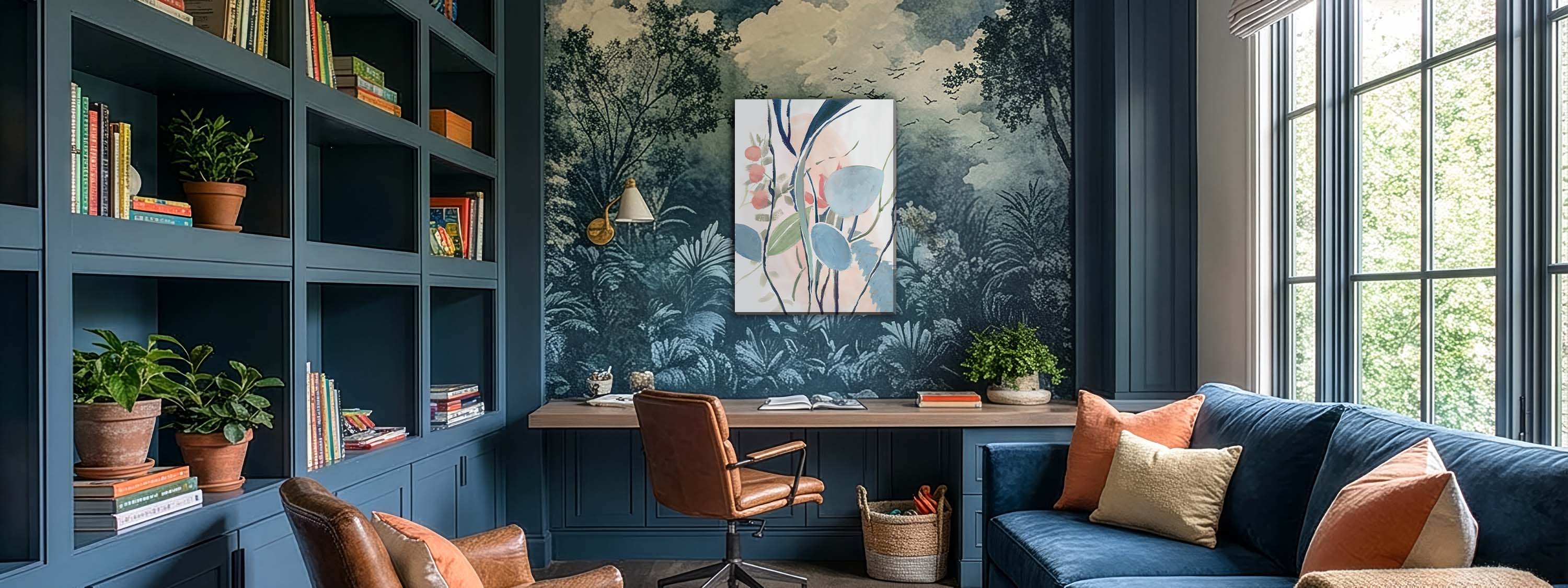
Home Office Wall Art: How to Choose Art That Supports Your Best Work
Most home office decisions are made backward. People ask "what should this room look like?" when the better question is "what kind of environment helps me do my best work?" Three of the six styles below answer a real functional question. The other three are simply about taste — and that's a completely legitimate reason to choose art too. Knowing which kind of decision you're making is what this guide is for.
Search for home office decorating advice and almost everything you find is organized around appearance: what looks professional, what photographs well on a video call, what signals success to a visitor. These aren't bad questions. They're just answered before the more important one.
The more important question is internal, not external: what does this room need to do for the way I actually think and work — or do I simply know what I like? Both are valid starting points. The mistake is not knowing which one you're actually answering.
Fine Art Canvas has been making canvas art since 1989. Every piece is designed in California and hand-made to order, with free 90-day returns and a 1-year warranty.

At a Glance
- The real question: Are you solving a functional problem, or choosing a look you love?
- Functional styles: Calm Focus (sustained attention), Creative Energy (generative work), Motivational (reconnecting with purpose)
- Taste styles: Modern Productivity, Abstract Modern, Mid-Century Workspace — honest preferences, no invented benefits
- Sizing: Primary wall 20"×24" to 24"×36"; side wall 16"×20" to 20"×24"; center at 57" from the floor
- The guide: Six styles, one decision framework — know which kind of choice you're making before you browse
In This Guide
Inventing a productivity justification for a style choice that's really about taste — or, just as often, ignoring a real functional difference (sustained focus vs. generative work) because a style "looked right" online. Either error leads to art that stops working for you within a few weeks.
Which Decision Are You Really Making?
Three of the six styles below are built on a real, specific research basis — they answer the question "what does this room need to help me do." The other three are style and era choices — they answer the question "what do I want this room to look like." Neither is more valid than the other; they're just different decisions.
Find Your Style
Does the room feel like it's competing with you — too busy, hard to settle into during focused work?
The room needs to get quieter. Reducing visual demand supports sustained, directed attention.
Read the Calm Focus Guide →Is most of your work generative — brainstorming, drafting, early-stage design, problem-solving from scratch?
Real research connects visually rich art to inspiration and creative-task performance — the opposite of the Calm Focus advice.
Read the Creative Energy Guide →Is the problem less about distraction and more about losing the thread of why the work matters?
A motivational question, not an attentional one. Purpose-connected art outlasts instruction-based art.
Read the Motivational Guide →Do you simply want a room with clear visual order and structured, intentional composition?
A real and valid taste preference — not a function the art performs, and worth choosing honestly as that.
Read the Modern Productivity Guide →Do you want bold, contemporary color and expressive form, independent of what kind of work you do?
Also a taste preference. The one real research finding here (psychological distance) is interesting but doesn't support a productivity claim.
Read the Abstract Modern Guide →Do you love the warm, organic, mid-century design era specifically?
An era and palette decision. Best paired with furniture in the same spirit.
Read the Mid-Century Workspace Guide →Most home offices land clearly on one of these six. A smaller number genuinely want two — a calm or expressive functional wall, paired with a style preference elsewhere in the room. Either way, the goal is to make the choice on purpose, knowing which kind of decision you're making.
Explore the Styles

Calm Focus
Muted, nature-adjacent art that gets out of your way during sustained, directed-attention work.
Read the full guide →
Creative Energy
Visually rich, expressive art for generative work — brainstorming, design, and open-ended problem-solving.
Read the full guide →
Motivational
Purpose-connected pieces that remind you what the work is for — without shouting about effort.
Read the full guide →
Modern Productivity
Confident composition and visual order for structured, client-facing, and strategic work.
Read the full guide →
Abstract Modern
Bold color fields and contemporary form — a style worth choosing purely because you love how it looks.
Read the full guide →
Mid-Century Workspace
Warm wood tones, organic-meets-geometric forms, and a restrained earthy palette from the mid-century design era.
Read the full guide →Calm Focus: Art That Gets Out of the Way
The most productive wall does not inspire you — it gets out of your way.
For sustained, directed-attention work, Calm Focus art works by subtraction — muted tones, organic forms, minimal composition, nature-adjacent subjects, drawing on the well-established Attention Restoration Theory.

River Birch II
Carol Robinson

Into The Woods
Nan

Distant Forest
Julia Purinton

Tree Study
Nancy Crowell
Full guide: Calm Focus Home Office Art
Creative Energy: Art for Generative Work
Calm walls help you stay on one track. Expressive walls help you find a new one.
A 2018 peer-reviewed study (An & Youn, Journal of Business Research) found that appreciating visually rich art can produce inspiration that measurably improves creative-task performance — the opposite advice from Calm Focus, for generative work.

Water Lilies And Japanese Bridge
Claude Monet

Abstract Sunrise
Osnat Tzadok

Beach Days
Randy Hibberd

Café Terrace at Night
Vincent Van Gogh
Full guide: Creative Energy Home Office Art
Motivational: What Good Motivation Actually Looks Like
The best motivational office art does not shout at you. It reminds you, quietly, what the work is for.
Real motivational art connects to purpose rather than to effort. A piece that reminds you what you are building toward — not one that tells you to build faster — is more durable.

Some Work in Acres, Not Hours
Donnie Quillen

Climb Every Mountain
Kyra Brown

Do What You Love
Melanie Viola

Adventure Awaits
Natalie Carpentieri
Full guide: Motivational Office Wall Art
Modern Productivity: Visual Order for Structured Work
A room that thinks the way you do.
Confident composition and resolved tonal structure that mirrors how organized, structured work feels. This is a taste preference, not a proven cognitive mechanism — and it's a strong one for client-facing and strategic work.

Nighthawks (1942)
Edward Hopper

Shimmering Light I
James Wiens

Sand Waves Zen Stones
DP Gallery

Succ III
Anne Seay
Full guide: Modern Productivity Office Art
Abstract Modern: Bold, Contemporary Expression
Not every choice needs a function.
Confident color fields and contemporary composition. Honest framing: there's no real productivity research behind this one (despite plenty of invented statistics online) — it belongs on your wall because you love how it looks.

Follow Us II
Tom Reeves

Aqueous
Brent Foreman

White Blues I Cartissi
Lori Ann Bellissimo

Abstract Stripes Blue
Danhui Nai
Full guide: Abstract Modern Home Office Art
Mid-Century Workspace: The Era and the Palette
An era and a palette, not a cognitive strategy.
Warm wood tones, organic-meets-geometric forms, and a restrained, earthy palette define the mid-century design era. Best paired with furniture in the same spirit — art alone won't carry the look.

Contemporary Nature II
Tava Studios

Dripping Gold I
Tom Reeves

Palm Springs
Sisi Seb

Blue Abstract
Simon Addyman
Full guide: Mid-Century Workspace Wall Art
Size and Placement in a Home Office
Home offices are almost always smaller than living rooms — and the art scale should reflect that.
Primary wall (behind the desk, on camera): one piece at 20"×24" to 24"×36". Large enough to read as intentional; contained enough not to overpower a modest room.
Side wall (peripheral vision, not primary focus): slightly smaller at 16"×20" to 20"×24". This is the best location for motivational work — present but not constantly in view.
Above the desk, eye-level seated: the center of the piece should land roughly 57" from the floor — museum hang height.
Creative Energy pieces work best in direct line of sight — unlike Calm Focus art, they're meant to be looked at, not faded into the background.
Modern Productivity, Abstract Modern, and Mid-Century Workspace all work fine on the primary wall, including camera-visible positions — there's no reason to hide a confident style preference.
Gallery walls in offices: proceed with caution. Limit to 3 pieces and keep the palette tightly unified.
For a full breakdown of sizing by room dimensions, see the Fine Art Canvas Wall Art Size Guide.
All Six Styles at a Glance
| Style | What It's For | The Decision It Teaches | Basis |
|---|---|---|---|
| Calm Focus | Sustained, directed-attention work | Does your wall settle the room or compete with it? | Functional — Attention Restoration Theory |
| Creative Energy | Generative, exploratory work | Is your work sustained-focus or generative — they need opposite environments | Functional — inspiration research (An & Youn, 2018) |
| Motivational | Reconnecting with purpose | Is the problem attentional or motivational — not the same fix | Functional — intrinsic/extrinsic motivation framework |
| Modern Productivity | Structured, client-facing, strategic work | Do you want visual order that mirrors organized thinking? | Taste preference — honestly framed as such |
| Abstract Modern | Bold, contemporary visual expression | Do you want this look, independent of work type? | Taste preference — honestly framed as such |
| Mid-Century Workspace | The mid-century design era specifically | Do you love this era and palette? | Taste preference — honestly framed as such |
About Fine Art Canvas. Every piece in this guide is designed in California and hand-made to order. We've been making canvas art since 1989. Every order ships with free 90-day returns and a 1-year warranty — so you can see the piece on your wall before you commit.
Available as canvas, framed canvas, or framed print. Custom sizes available on most pieces.
Find the style that fits the way you work — and see it on your wall before you commit.
Browse Home Office Wall ArtFrequently Asked Questions
Should I choose office art for Zoom calls?
No, not as the primary reason. Choose art that supports the work first; if it also looks good on camera, that's a side benefit, not the goal. Art chosen only for how it performs on a screen tends to stop meaning anything within a few weeks.
Does office artwork actually improve productivity?
There's no reliable evidence that any specific genre of art makes you measurably more productive, and most claims circulating online citing dramatic statistics aren't traceable to real studies. What is well-supported: natural imagery helps attention recover after focused work, visually rich art has a real link to creative-task performance, and art you've chosen deliberately tends to keep mattering longer.
How do I know which of the six styles is right for me?
Start by asking whether you're solving a functional problem (focus, creativity, motivation) or simply choosing a look you love. If it's functional, Calm Focus, Creative Energy, and Motivational each answer a different version of that question. If it's about taste, Modern Productivity, Abstract Modern, and Mid-Century Workspace are equally legitimate choices on their own terms.
What if I simply prefer a style even if it isn't considered "optimal"?
Preference is a completely legitimate reason to choose art. Not every choice needs to be justified by a cognitive benefit. Modern Productivity, Abstract Modern, and Mid-Century Workspace are all wonderful collections to browse purely on taste — we'd rather say that honestly than invent a function they don't perform.
Know which decision you're making. Three of these six styles solve a real functional problem. The other three answer a question of taste. Both are good reasons to choose art — just don't confuse one for the other.


Leave a comment
This site is protected by hCaptcha and the hCaptcha Privacy Policy and Terms of Service apply.