
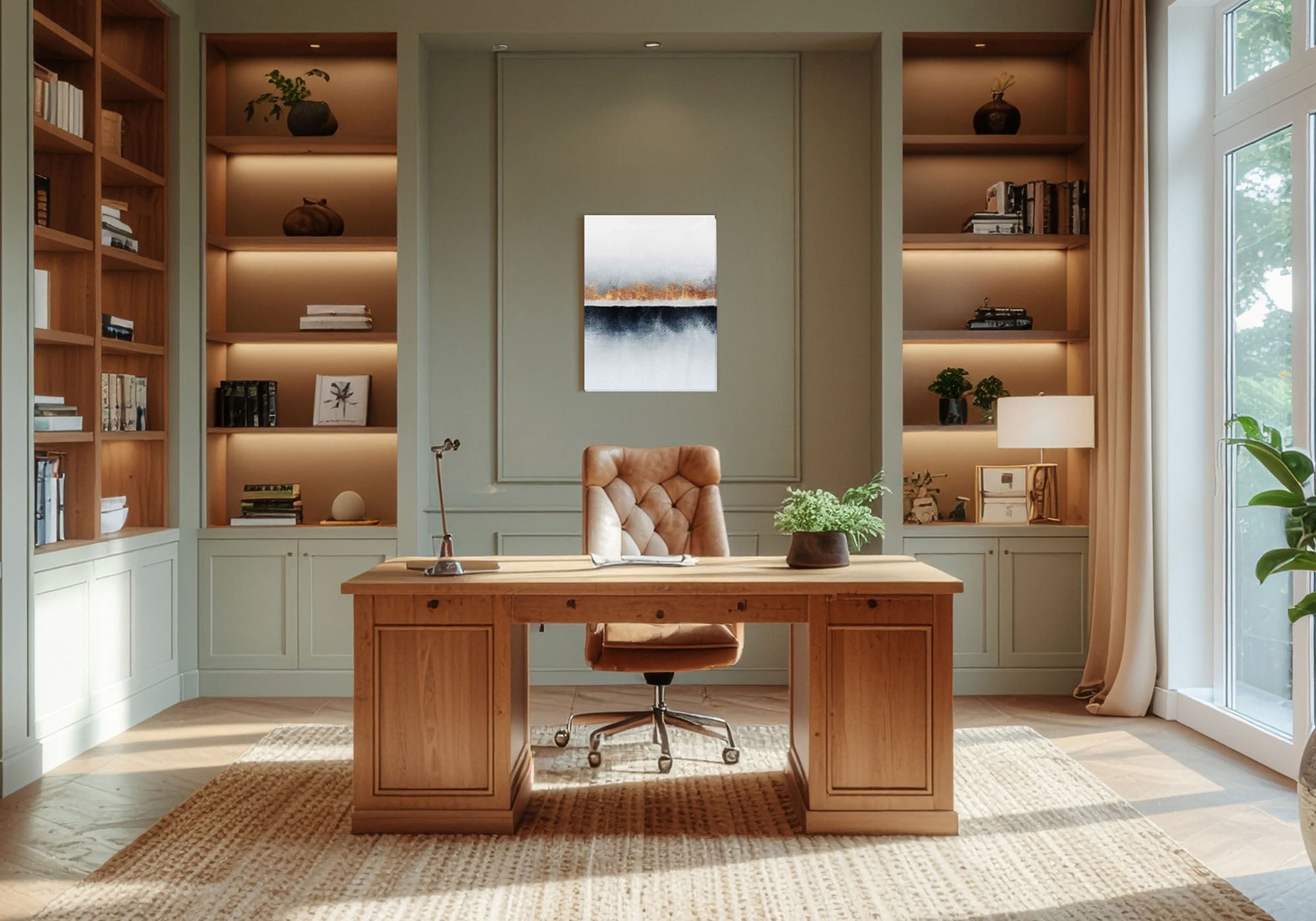
Modern Productivity Office Art: When the Room Thinks the Way You Do
For structured, client-facing, or strategic work, the right office art has clear visual logic — confident composition, intentional tonal contrast, a sense that every element is placed with purpose. The room should mirror the way organized thinking feels, not display it.
The Zoom Backdrop Trap
The most common reason people choose modern, structured art for a home office is the camera. It looks professional. It photographs well. Colleagues notice it and form a favorable impression. This is real — and it is a trap.
Choosing art for the camera means you are solving for a 60-minute-per-day problem (video calls) at the expense of an eight-hour-per-day one (actual work). The question worth asking is not “How does this look on Zoom?” but “Does this room support the way I actually work?”
When Modern Productivity art is chosen for the right reasons — because the visual clarity of the room reinforces the visual clarity of the work — it is one of the most durable and effective choices in the home office category. It does not just look good. It functions.
Every piece from Fine Art Canvas is designed in California and hand-made to order — making canvas art since 1989, with free 90-day returns and a 1-year warranty.

At a Glance
- Style: Intentional compositions with clear visual logic and confident tonal structure
- Best for: Strategic, client-facing, or project-management work — rooms that manage multiple threads
- Look for: Strong geometry, resolved composition, decisive color, and a sense of visual completeness
- Not for: Deep single-thread focus where the wall should disappear — that is Calm Focus
- Start with: 24″×36″ on the primary wall, gallery-wrapped or in a simple black frame
When This Style Is Right for You
The choice between Modern Productivity and Calm Focus comes down to what kind of cognitive demand the work places on you.
Choose Calm Focus if the work requires long, unbroken stretches of directed attention — reading, writing, analysis, code. The wall should disappear. Any visual structure, even organized structure, competes with sustained attention.
Choose Modern Productivity if the work has inherent structure — planning, strategy, client work, project management. Here, organized visual structure is complementary rather than competitive. The room can have a clear visual logic without that logic pulling at attention, because the work already has that shape.
If you are unsure which applies, the deciding question is: does your best work happen when time disappears (Calm Focus), or when you are actively managing multiple threads and outputs (Modern Productivity)? Both are valid modes; the art should match the mode.
How to Recognize It
Modern Productivity art is not minimalism and it is not abstraction — although it overlaps with both. The defining quality is intentionality: the sense that every compositional decision is resolved and purposeful. Nothing wasted, nothing accidental, nothing decorative-without-reason.
Hopper’s Nighthawks is the canonical example not because it is minimal but because it is composed. Every light source justified. Every figure placed exactly where the composition requires. The geometry of the counter, the window, the street outside — all of it held in a visual logic that feels inevitable. That quality — inevitability — is what Modern Productivity art aims for.
In practical terms, this means:
- Strong tonal structure — light and shadow that organizes the picture plane
- Clear compositional geometry — even when the subject is organic, the framing is resolved
- Confident color decisions — not many colors, but each one placed with intention
- A sense of visual completeness — the piece looks finished, not in process
✓ This Style Is for You If
- Your work involves managing multiple threads — strategy, planning, client calls, project management
- You want the room to have clear visual order that complements organized thinking
- You prefer compositions that feel resolved, decisive, and intentionally placed
- You like a professional environment that reflects genuine aesthetic taste, not just a backdrop
✗ Look Elsewhere If
- Your best work happens when time disappears and the room fades away — try Calm Focus
- You want art that delivers a specific message or mantra — try Motivational
- You prefer atmospheric, expressive, or unresolved compositions — try Creative Energy
- You want bold geometric patterns without figurative content — try Abstract Modern
The test for Modern Productivity art: look at the piece and ask whether it feels decided. Not dramatic, not loud — decided. The composition should feel like it could not have been arranged any other way. That quality of resolution is what creates the visual groundedness that structured work benefits from.
How to Use It Well
Modern Productivity art can occupy the primary wall behind the desk — including camera-visible positions — because its visual character (organized, resolved, confident) is genuinely compatible with work rather than distracting from it. This is in contrast to Motivational art, which is better positioned out of the primary field of vision.
- Behind the desk, at or slightly above eye level: center the piece at 57 inches from the floor for standing viewing; this reads as slightly below eye level when seated, which is comfortable and intentional.
- One strong piece rather than a collection: Modern Productivity art works through clarity and resolution. Multiple pieces at the same visual weight compete with that quality.
- Size: 24″×36″ is a strong choice for the primary wall in a home office. Large enough to carry the room; contained enough for a domestic scale. See the Wall Art Size Guide.
- Frame or frameless: Modern Productivity art works well frameless (gallery-wrapped canvas reads clean) or in a simple black or dark wood frame. Ornate frames work against the visual language of this style.
Works That Carry This Quality
| Piece | Why It Works for Structured Offices | Best Placement |
|---|---|---|
| Nighthawks (1942) — Edward Hopper | Masterclass in compositional resolution. Every element placed with purpose. Strong geometry without being cold. | Primary wall, behind the desk. Strong enough to anchor a room. |
| Shimmering Light I — James Wiens | Abstract but architecturally grounded. Tonal confidence without drama. Reads as settled from across a room. | Primary or side wall. Works at multiple scales. |
| Sand Waves Zen Stones | Natural subject, geometric composition. The visual order of raked sand is inherently structured without being rigid. | Side wall or adjacent to the desk. Provides visual rest with visual order. |
| Succ III — Anne Seay | Clean botanical geometry. Each form placed as if deliberately arranged — because it was. Modern without being corporate. | Beside a monitor or on a narrow wall. Scale-flexible. |
Made to order. Every Fine Art Canvas piece is designed in California and hand-made to order. Choose from gallery-wrapped canvas, framed canvas with a black floater frame, or framed fine-art prints with a slim white mat. Free 90-day returns and a 1-year warranty on every order.
Our Picks for Modern Productivity Offices

Nighthawks (1942) — Edward Hopper
Shop this piece →

Shimmering Light I — James Wiens
Shop this piece →

Sand Waves Zen Stones
Shop this piece →

Succ III — Anne Seay
Shop this piece →

Succ II — Anne Seay
Shop this piece →

Crystal Urns II — Cartissi
Shop this piece →
Common Mistakes with Modern Productivity Art
Choosing art because it photographs well on Zoom — then discovering it has no relationship to how you work. A sleek, corporate-looking piece that projects competence to the camera but means nothing to you personally will stop registering within two weeks. You will stop seeing it. Choose for the work, and the camera benefit arrives as a side effect.
Hanging multiple pieces at the same visual weight. Modern Productivity art works through clarity and resolution — one strong piece that anchors the room. Multiple competing compositions at equal weight undermine the very quality of visual order this style depends on.
Confusing structured with sterile. A piece with clear visual logic does not have to feel cold or clinical. Warm tonality, organic subjects within resolved compositions (like Anne Seay’s botanical work), or rich tonal contrast (like Hopper) all carry the quality of intentionality without sacrificing warmth. If the room feels cold, the fix is usually the surrounding materials — warm wood, textured shelving — not switching to softer art.
Ready to find the right piece for your workspace?
Shop Modern Productivity Office ArtFrequently Asked Questions
What is modern productivity art for a home office?
Modern Productivity art is wall art with clear visual logic — confident composition, intentional tonal structure, and a sense of completeness. The defining quality is intentionality: the sense that every element in the piece is placed with purpose. This visual character supports structured, organized work by providing a room environment that mirrors the clarity organized thinking requires. Edward Hopper’s Nighthawks is the canonical example — not minimal, but completely resolved.
Is modern art good for a home office?
Modern art works well in a home office when it has strong compositional resolution — a clear visual logic rather than feeling open-ended or agitated. Abstract pieces with strong tonal structure, confident geometry, and a settled quality are excellent choices. Modern art that reads as energetic, chaotic, or unresolved can increase background visual stimulation. The question is not whether the piece is modern but whether it feels decided.
What art looks professional in a home office?
Art that looks professional in a home office is art with clear visual resolve — a strong composition, a limited and intentional palette, and no sense of visual clutter or confusion. But professional-looking art chosen only for that reason tends to feel generic and lose meaning quickly. The more durable choice: art that looks professional because it reflects a genuine visual aesthetic you work well in. Those two outcomes often coincide; the reason for choosing matters for how long it satisfies.
Should I choose black and white art for my office?
Black and white art is one of the strongest options for Modern Productivity offices because tonal contrast without color variation is inherently organized and resolved. It reads as deliberate, it photographs extremely well, and it does not date. The risk is feeling cold or clinical in a domestic space. Counter that with warm natural materials — a wood desk, warm-toned shelving — that add the warmth the art does not need to provide.
What is the difference between calm focus and modern productivity office art?
Calm Focus art works by subtraction — it removes visual demand so attention can go fully to the work. It is best for deep, sustained, single-thread focus: writing, analysis, reading, code. Modern Productivity art works by providing organized visual structure that complements structured cognitive work: planning, strategy, client management. The distinction is between work that needs the room to disappear and work that can coexist with — and even benefit from — a room that has clear visual order.
A modern productivity office is not a backdrop — it is an environment. Choose art with the visual logic your work already has: organized, resolved, decided. The camera will agree, but that is beside the point.


Leave a comment
This site is protected by hCaptcha and the hCaptcha Privacy Policy and Terms of Service apply.