
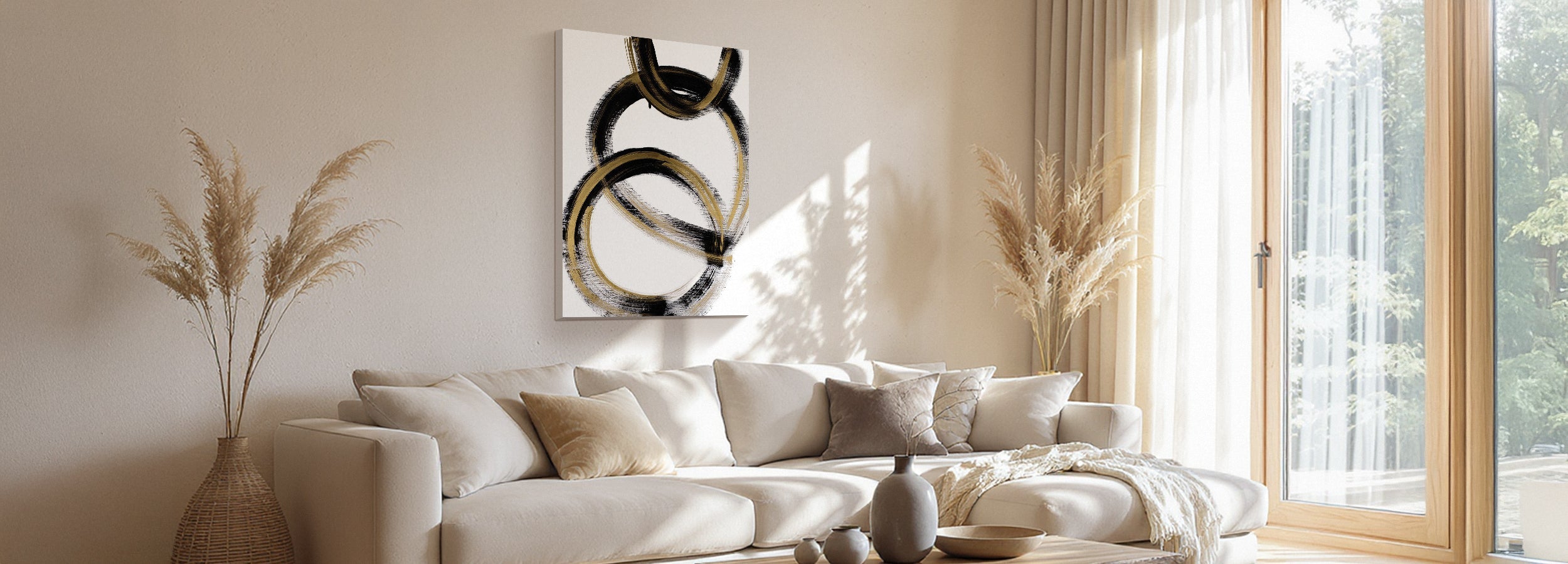
Modern Minimalist Wall Art for Living Rooms
Modern minimalist living room wall art means choosing one well-scaled piece — a soft neutral abstract, a quiet line drawing, or a low-contrast landscape — and giving it room to breathe. Lean warm rather than stark, choose texture over flatness so the wall doesn’t feel cold, and go one size bigger than feels safe. It’s the right style if you want a calm, uncluttered room where the art sets the mood without shouting.
A minimalist living room can feel like the hardest one to decorate, precisely because there’s nowhere to hide. With less on the walls, the one thing you do hang carries the whole room. Get it right and the space feels calm and considered; get it wrong and it feels either bare or, more often, a little cold. This guide is about getting it right — not by adding more, but by choosing better.
Designed in California. Hand-made to order. Fine Art Canvas has been making canvas art since 1989, and every piece comes with free 90-day returns and a 1-year warranty.

At a Glance
- One oversized statement piece — not a cluster of small ones
- Warm neutral palette: stone, sand, oatmeal, greige
- Generous negative space around the art
- Real canvas texture over a flat, lifeless print
- One or two dominant colors, at most one quiet accent
Minimalism isn’t about owning less — it’s about asking more of every piece you choose. When one artwork is doing the work of five, it has to earn its place: it should set the calm, carry the texture, and hold the wall on its own. That single shift explains every decision below — one piece instead of a cluster, larger instead of smaller, warmth instead of bare white. The most common way a minimalist room goes wrong isn’t clutter. It’s coldness — and the fix is asking your one piece to bring warmth, not just fill space.
When Modern Minimalist Is the Right Answer
Once you’ve decided which wall you’re filling — the Living Room Wall Art Guide walks through that, starting with the wall, not the art — the next question is which style solves it. Reach for modern minimalist when the room itself is already doing a lot: an open-plan space, big windows, clean-lined furniture, a neutral palette you don’t want to fight. In those rooms, busy art competes; a single quiet piece completes. People choose minimalist art because they want the room to feel calm the moment they walk in, and because they’d rather own one piece they love than a wall of pieces they merely like.
How to Recognize It
You don’t need design vocabulary to spot it. You’re probably looking at modern minimalist when:
Your eye lands on one piece, with generous empty space around it, rather than scanning a busy wall. The room feels calm before you notice the furniture. There are only one or two dominant colors, usually warm neutrals — stone, sand, oatmeal, soft greige — with maybe a single quiet accent. The art is abstract, organic, or low-contrast — a soft shape, a line drawing, a hazy landscape — not a detailed, high-contrast scene.
Underneath the look, the palette is the giveaway: warm neutrals over stark white, with negative space treated as part of the composition rather than empty wall to fill.
Is This Style Right for Your Home?
Modern Minimalist Is Ideal If…
- You find visual clutter tiring and want the room to feel restful
- You have open-plan or light-filled spaces
- Your furniture already has clean, simple lines
- You’d rather own fewer, better things than fill every wall
Look at Another Style If…
- You love collecting and layering — a gallery wall makes you happy, not anxious
- Your room already feels cool or sparse and needs warming up
- You enjoy pattern, color, and a more decorated look
If you’re on the warmer side of that line, two neighboring styles get you most of the calm with more comfort: Warm & Earthy if your room feels too stark and you want it cozier, or Biophilic Nature if you want the same quiet with more organic, natural texture.
How to Use It Well in a Living Room
Warm it up. Choose soft, warm neutrals — sand, oatmeal, greige — over pure cold white, and favor a real canvas surface with visible texture. On a neutral wall, that texture is what keeps the piece from reading clinical. This is the single most important call in a minimalist room.
Go one size bigger than feels safe. The most common minimalist mistake is art that’s too timid for the wall. A confident, larger piece reads as intentional; a small one reads as an afterthought.
Let it be the one busy thing — or the one quiet thing. If the room is calm, a piece with a little movement gives the eye somewhere to rest. If the room already has texture and pattern, keep the art quiet. Don’t make the wall compete with itself.
Use a calm pair for symmetry. Above a long sofa, two matched pieces hung close can balance the width while keeping the negative space minimalism depends on — cleaner than a five-piece gallery.
Get the scale right, then stop. Span about two-thirds to three-quarters of the sofa’s width and hang it 6–10 inches above the back. For the full sizing method, see the Living Room Wall Art Guide and our Wall Art Size Guide.
Minimalist rooms are unforgiving of the wrong scale, so check it first. Use View in Your Room on any product page to see the exact piece on your wall at true size, or tape out the dimensions on the wall and live with the outline for a day.
About Fine Art Canvas. Every piece in this guide is designed in California and hand-made to order — available as canvas, framed canvas, or framed print, in the exact size your wall needs. Backed by free 90-day returns and a 1-year warranty.
Why These Six Pieces Work
A few from our Modern Minimalist collection that earn their place — each chosen for what it does in a calm room, not just how it looks. Every piece is hand-made to order in your size and finish.

White Band I
cartissi

White Band II
cartissi

Love on Steroids II
Kent Youngstrom

Abstract Birds 1
Design Fabrikken

Distant Forest
Julia Purinton

Dreamy Day
Julia Purinton
Common Mistakes (and the Fix)
Timid art is the classic minimalist miss. Fix: span 60–75% of the sofa and size up when in doubt.
Pure white on a white wall feels clinical. Fix: choose warm neutrals and a textured canvas surface.
A grey piece on a grey wall disappears. Fix: let the art sit a step warmer or cooler so it still registers.
Too many frames breaks the calm minimalism depends on. Fix: one larger piece, or a clean matched pair.
A thin print undercuts the whole look. Fix: real canvas texture is what makes one quiet piece feel considered.
Every piece is hand-made to order in your chosen size and format.
Shop Modern MinimalistFrequently Asked Questions
What is modern minimalist wall art?
It’s art that strips a scene down to its essentials — clean shapes, a limited, usually neutral palette, and plenty of negative space. Think soft abstracts, line drawings, and low-contrast landscapes chosen so a single piece can carry a calm, uncluttered room.
How do I keep minimalist art from feeling cold?
Warm the palette and add texture. Choose soft, warm neutrals over stark white, and pick a real canvas surface with visible texture rather than a flat print. One organic or hand-made note — a soft shape, a hazy landscape — is usually all it takes to make a minimalist wall feel calm instead of clinical.
What size art should I hang above the sofa?
Span about two-thirds to three-quarters of the sofa’s width and hang it 6–10 inches above the back, centered around 57–60 inches from the floor. In a minimalist room especially, size up when you’re between sizes. The Living Room and Size guides have the full method.
One piece or a set?
Usually one. Minimalism rewards a single confident piece over a cluster. The main exception is a matched pair above a long sofa, which adds symmetry while keeping the calm. If you want a set, keep it to a tight, tonal group of two or three — never a scattered gallery wall.
What colors work in a minimalist living room?
Warm neutrals do the heavy lifting — stone, sand, oatmeal, soft greige — with at most one quiet accent like sage, charcoal, or a muted blue. The goal is one or two dominant tones, not a full palette.
Can minimalist artwork make a room feel cold?
It can — that’s the most common way the style goes wrong. A stark, all-white piece on a white wall reads clinical. The fix is warmth: soft, warm neutrals, real canvas texture, and one organic note. Done that way, minimalist art reads calm, not cold.
Does minimalist art work in a small living room?
Yes — it’s often the best choice for a small room, because empty space reads as calm rather than sparse. Hang one well-scaled piece instead of several small ones, and resist crowding the walls.
Minimalism succeeds when every piece has a purpose — one exceptional artwork will always do more than several that merely fill space.


Leave a comment
This site is protected by hCaptcha and the hCaptcha Privacy Policy and Terms of Service apply.