
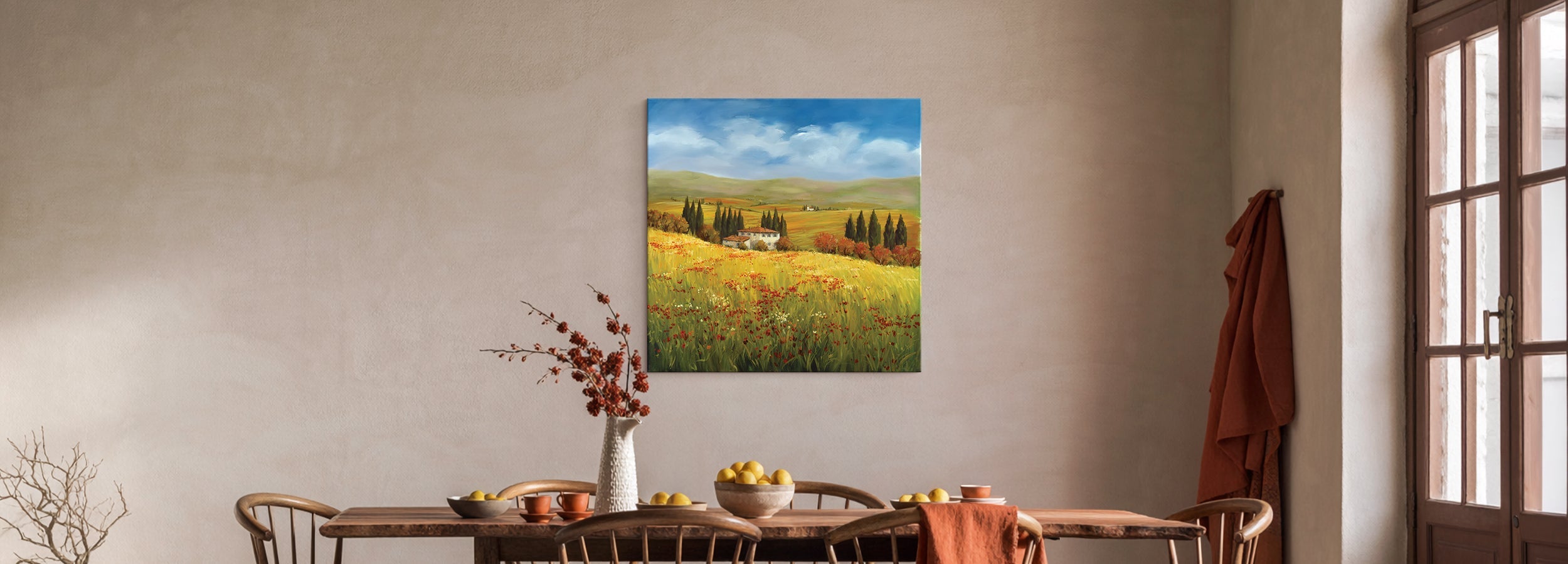
Italian Countryside Art for the Dining Room
Italian countryside art works because it puts a real place on the wall. A Tuscan hillside, a sunlit village alley, the long lunch by the lake — it brings travel to the table, the kind that makes a guest nod at the wall and ask, "have you been?" That question is the whole point: the room stops being a dining room and starts being somewhere. The painting doesn't transport anyone on its own — the people and their stories do that. What a good Italian scene gives the table is a doorway, and a reason to walk through it together.
Italian countryside art is about a place, not a palette — choose a scene you'd want to walk back into, and the table will follow you there.
Every piece is designed in California and hand-made to order by Fine Art Canvas, making canvas art since 1989. Warm Mediterranean light is exactly the kind of depth that flattens on a cheap print, so a made-to-order canvas earns its keep here — the place looks like somewhere you could walk into, not a postcard of it. Free U.S. shipping over $100, 90-day returns, and a 1-year warranty on every order.

Italian Countryside — At a Glance
- Best for: People who love to travel — or dream of it — and want the table to wander somewhere warm
- The feeling: The long Mediterranean lunch — unhurried, golden, in no rush to end
- What to look for: A real, specific place with depth — hillsides, villages, lakes, and coastlines you could step into
- Watch out for: Generic "Tuscan-toned" prints with no real place, and vineyard-logo or wine-label clichés
- The test: Could someone ask "have you been?" and mean it?
When Italian Countryside Is the Right Answer
This is the route for the table that likes to travel. It suits anyone who has wandered an Italian village — or wants to — and would love the dining room to carry a little of that warmth and ease. If you want the long-lunch feeling, where no one's watching the clock, and you'd like the wall to give guests somewhere to go, Italian countryside is where to start.
Once you've settled that the evening you want is one of place and travel warmth — the Dining Room Wall Art Guide walks through choosing the evening first — Italian countryside is the route that delivers it. If you want curiosity and interpretation instead, that's Conversation Art. If you want cozy, casual warmth closer to home, that's Modern Farmhouse.
How to Recognize It
The difference between Italian countryside art and "warm-toned decor" is simple: a real place. Look for a specific, recognizable place — a Tuscan hillside, an Italian lake, a village alley, a stretch of coastline — somewhere you could name. Warm Mediterranean light — the golden, late-afternoon glow that makes the whole room feel unhurried. And depth you could step into — a scene with distance and air, not a flat pattern in terracotta tones.
What to skip: a print chosen only for its "Tuscan palette," with no actual place in it, and the vineyard-logo or wine-bottle cliché — that's restaurant decor, not a doorway. The test is whether someone could ask "have you been?" and mean it.
The Same Italian Scene, a Different Job Than in the Kitchen
Italian scenery shows up in kitchens too — and it should; it's right at home there. But the job changes with the room. In the kitchen, a Tuscan scene is the cook's café-pause: glanced at over the stove, it sets a warm mood while you work. In the dining room, the same scene hangs in everyone's seated sightline, over the table or the sideboard, where it becomes a travel-prompt — the thing a guest settles into and asks about. Same place, different doorway: one keeps the cook company, the other opens the table. If it's your kitchen you're styling, our Tuscan Charm kitchen guide covers that side.
✓ Italian Countryside Is for You If…
- You love to travel, or love the dream of the long Italian lunch
- You want warmth and ease more than formality
- You'd like the wall to give guests somewhere to go
- You have a focal or sideboard wall in the seated sightline
✗ Look at Another Style If…
- You want curiosity and interpretation — try Conversation Art
- You want refined, formal occasion — try Elegant Classic
- You want cozy, casual warmth closer to home — try Modern Farmhouse
How to Use It Well
Five moves make Italian countryside art earn its place at the table:
Choose a Place, Not a Palette
Pick the scene you'd most want to walk back into — that's the one that will open conversation, not the one that merely matches your walls.
Hang It in the Seated Sightline
Over the table or the sideboard, where the whole table can see it and travel there together — not on a wall guests sit with their backs to.
Go Big, or Hang a Pair
A place needs room to open. Size to about two-thirds the wall or table width, or hang a matched pair across a long wall.
Let the Warm Tones Carry the Room
Mediterranean light does quiet work — keep the surrounding palette calm and let the scene set the temperature.
Hang It for Seated Eyes
A little lower than usual, so the place meets people at the table.
Over the table, size to about two-thirds the table width; above a sideboard, two-thirds to three-quarters the furniture width. The Wall Art Size Guide has the full breakdown.
Every piece is designed in California and hand-made to order in the size and format you choose — canvas, framed canvas, or framed print. The warm light and depth of the place arrive true rather than flattened. Free U.S. shipping on orders over $100, 90-day hassle-free returns, and a 1-year warranty on every order.
Why These Six Pieces Work
Each one puts a real place on the wall — somewhere a guest could ask about, and you could tell the story. Every piece is hand-made to order in the size and format you choose.


Common Mistakes (and the Fix)
Buying the palette, not a place. A terracotta-toned print with no real scene reads as decor, not a destination. Fix: Choose somewhere you could name.
Defaulting to wine-and-vineyard clichés. Logo-style bottles and grapes are restaurant signage. Fix: A real hillside or village does far more for a home.
Going too small. A place needs room to open. Fix: Size up, or hang a matched pair across a longer wall.
Theming the whole room "Italian restaurant." One strong scene carries it. Fix: Layered props and slogans tip it from warm into kitsch.
Hanging it out of the sightline. If the table can't see it, it can't travel there. Fix: Keep it on the focal or sideboard wall, at seated height.
Every piece is designed in California and hand-made to order, backed by free U.S. shipping over $100, 90-day returns, and a 1-year warranty.
Shop Italian CountrysideFrequently Asked Questions
What makes art "Italian countryside" rather than just warm-toned?
A real, specific place. Italian countryside art shows somewhere you could name — a Tuscan hillside, a village alley, an Italian lake or coastline — rendered with warm Mediterranean light and real depth. A print chosen only for its terracotta palette, with no actual scene in it, is warm decor; it isn't a place you can travel to, which is the whole appeal of the style.
Is Italian countryside art too theme-y for a dining room?
Not when it's a real place rather than a cliché. One genuine scene — a hillside, a village, a lake — reads as warmth and travel, not kitsch. It tips into theme-y only when you layer on vineyard logos, wine-bottle motifs, and slogans. Choose a single, believable place and let it carry the room.
Where and how big should I hang it?
On the focal wall behind the table or above the sideboard, in everyone's seated sightline. Size to about two-thirds the table or furniture width, and hang a little lower than usual because the room is experienced seated — over a sideboard, leave roughly 6 to 10 inches above the surface.
Can I use a pair of Italian scenes?
Yes, and it's one of the nicest moves in this style. A matched pair — like two views of the same village alley — turns a long dining wall into a sequence, almost a walk through the place. Keep the two pieces related in palette and subject so they read as one idea, and center the pair as a unit.
Should my kitchen and dining room both use Italian scenes?
They can, and they'll do different jobs. In the kitchen, a Tuscan scene is the cook's warm backdrop, glanced at while you work. In the dining room, it sits in the seated sightline and becomes a travel-prompt that opens conversation. If you want both, vary the specific places so the rooms feel connected rather than repeated — our Tuscan Charm kitchen guide covers the kitchen side.
Isn't this just wine and vineyard art?
No — and that's the cliché to avoid. Wine bottles, grapes, and vineyard logos are decor motifs; they don't take the table anywhere. True Italian countryside art is about the landscape and the places — the hills, villages, lakes, and light — which is what gives a guest something real to ask about and remember.
Italian countryside art works when it's a real place, not a palette — choose the scene you'd want to walk back into.


Leave a comment
This site is protected by hCaptcha and the hCaptcha Privacy Policy and Terms of Service apply.