
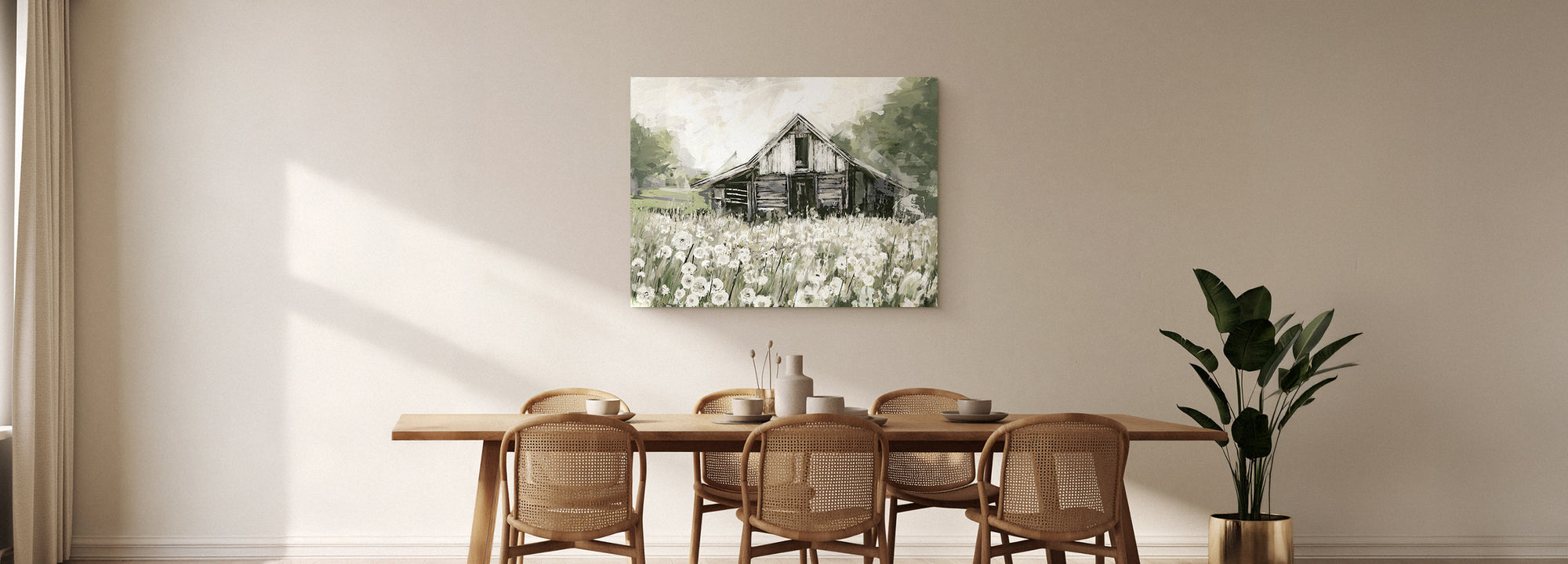
Dining Room Wall Art: The Complete Guide
Dining room wall art has a different job than art anywhere else in the house. The dining room is the one room built for staying — the long meal, the second bottle of wine, the conversation no one wants to end. Its art isn't there to match the food on the table. It's there to shape the atmosphere that keeps everyone around it. So the real question isn't "what goes with my table." It's "what kind of evening do I want people to have here." Answer that, and the rest — the mood, the scale, where it hangs — follows.
Most dining room art advice — and most dining room art — defaults to the meal: a "gather" sign, a wine motif, a bowl of fruit. It's an understandable reflex; this is the room with the food. But the food is already on the table. The art's job is to elevate everything happening around it — the talk, the company, the hours that pass without anyone noticing. That's a higher bar than "matches the meal," and it's the whole reason this guide exists.
Every piece is designed in California and hand-made to order by Fine Art Canvas, making canvas art since 1989. Free U.S. shipping over $100, 90-day returns, and a 1-year warranty on every order.

Dining Room Wall Art — At a Glance
- First decision: Choose the evening, not the style — picture the dinners this room is for, and the art almost chooses itself
- Art that earns a dining wall: Openers (curiosity, story, place, memory) or sustainers (depth, warmth, beautiful light, slow detail)
- Skip food-and-wine art: The food is already on the table — reach for atmosphere, not the obvious
- Size to the table: About two-thirds the table width for the focal wall; two-thirds to three-quarters for a sideboard
- Hang for seated eyes: Lower than usual — center near 58–60 inches, so the art meets people at the table
- Five routes below: Conversation Art, Elegant Classic, Italian Countryside, Retro & Vintage, and Modern Farmhouse — each one a different way to make people want to stay
In This Guide
- Why a dining room is different from every other room
- Why some dining rooms make people want to stay
- How art creates the experience: openers and sustainers
- What kind of evening do you want people to remember?
- Why you read both the Kitchen and Dining guides
- Where dining room art goes — and how big
- Five routes to the experience
- Common mistakes (and the fix)
- Pieces that set the table
- Frequently asked questions
Why a Dining Room Is Different from Every Other Room
Every room asks something different of its art. A kitchen is about activity — art caught in glances, on your feet. A living room is about personality. A bedroom is about restoration. The dining room is the only room in the house intentionally designed around a shared experience that's meant to last. People sit down, face one another, and stay — often for hours. No one lingers in a hallway. Everyone lingers at a good table.
That changes the art's role completely. Here it isn't decoration you walk past; it's part of how the room hosts. The right piece is one of the quiet ways you welcome people, set the tone, and tell everyone — without saying it — that this evening was worth sitting down for.
Why Some Dining Rooms Make People Want to Stay
Think about the dinners you actually remember. They're almost never remembered because someone admired the artwork. They're remembered because nobody wanted to leave the table. A room earns that feeling — and while the lighting, the comfort, and the company do most of the work, the art does a quiet share of it that most people never consciously notice.
Here is how it does that, concretely. A piece a guest can't quite place gives the table a question to sit with. A scene of somewhere real turns into "have you been? — we have to go." Soft light on a wall gives the whole room permission to relax. A canvas with genuine depth says, without a word, that this evening was worth setting the table for. None of it is loud. All of it adds up to a room people sink into instead of pass through.
That's the shift worth making before you choose anything: the best dining room art isn't decorating the dinner. It's extending it — turning a meal into an evening, and a room people eat in into a room people stay in.
How Art Creates the Experience: Openers and Sustainers
Art earns its place at a dining table in one of two ways — by starting something, or by holding the room. The strongest dining rooms use a little of both.
Openers — Art That Starts Something
You recognize an opener by the reaction it draws out of a guest: curiosity ("what is that?"), story ("what's happening there?"), place ("have you been?"), memory ("that takes me right back"), or a light, human wit that loosens the room and earns a smile.
Sustainers — Art That Keeps People There
These don't announce themselves. They reward a long, slow evening: depth that isn't used up in one look, warmth and ease that settles people in, beautiful light that relaxes the whole table, and slow detail — the things you only notice over the second glass.
One thing worth saying plainly: conversation-worthy almost never means loud. The pieces that truly hold a table are usually the quiet ones — a remembered place, a soft light, a detail discovered late in the evening. That's a more considered idea than the "statement piece," and a more durable one.
The single thing to avoid is art that says everything in a second. A sign reading "EAT, DRINK & BE MERRY" is legible in one glance and then finished — there's nothing left to look at, and nothing to talk about. A kitchen can wear a one-liner; it's the working room, and the line is part of its character. The dining room, the one room built for staying, needs art with a second thing to say.
What Kind of Evening Do You Want People to Remember?
"A relaxed Sunday brunch, or the everyday family meal."
You want ease and warmth — art that settles people in rather than impresses them. Start with Modern Farmhouse.
"A wine-and-cheese evening with friends."
You want curiosity and a little travel — art that opens conversation and wanders somewhere. Start with Conversation Art or Italian Countryside.
"A holiday dinner full of regulars."
You want memory and story — art that carries history and starts a "remember when." Start with Retro & Vintage.
"A formal celebration."
You want depth and occasion — one serious piece that tells the table the evening matters. Start with Elegant Classic.
Notice you chose the evening before the style. That's the order that gets you a dining room that feels like yours rather than like a showroom — and it's the through-line of every style guide below.
Why You Read Both the Kitchen and Dining Guides
If your home has both rooms — or an open plan with both zones — they do nearly opposite jobs, and that's the cleanest way to keep them from blurring together.
The kitchen asks: what supports the person making the meal? It's art for glances, on your feet, where food and coffee character is right at home. The dining room asks: what creates the experience after everyone sits down? It's art for the long look, the gathering, the mood of the evening. The most common mistake is theming the dining room like a kitchen — hanging "food" art in the room where the food already is. Read both and you'll style the cook's room and the guests' room differently, which is exactly how the best homes do it. Start with the Kitchen Wall Art Guide for that side.
Where Dining Room Art Goes — and How Big
A dining room usually gives you one true focal wall — the wall the table anchors — and often a sideboard or buffet wall. Those are your two spots. And the dining room hands you two freedoms the kitchen never does: you view the art seated, and there's no heat or steam to work around. So you can hang lower, go bigger, and choose finer — large canvases, or framed pieces under glass — without a second thought for the cooktop.
| The Spot | Size | Height |
|---|---|---|
| The focal wall behind the table | One large piece, or a balanced pair or triptych — about two-thirds the table width | Lower than usual — center near 58–60 inches, or lower so it reads for seated guests |
| Above a sideboard or buffet | About two-thirds to three-quarters the sideboard width | Bottom of the art about 6–10 inches above the surface |
| A narrow wall between doorways | Go vertical and fill most of the height | Centered in the open run |
| A long, empty wall | An oversized single piece, or a deliberate pair — size up | Center near 58–60 inches |
Because dining art is viewed seated as much as standing, hang a touch lower than you would elsewhere so it meets people at the table rather than floating above their heads. And over a long table, one generous piece — or a deliberate, matched pair — almost always beats a scatter of small frames. For the full room-by-room breakdown, see our Wall Art Size Guide.
Before any piece earns a dining wall, give it the one test that matters in this room: would it make someone want to linger? Beautiful is the floor. Lingering is the standard — and it's a surprisingly good filter for narrowing a wishlist of pieces you love down to the one that belongs over the table.
Five Routes to the Experience
Each of the five dining styles is really a different way to make people want to stay. Start from the evening you pictured above, then follow it into the right guide.

Conversation Art
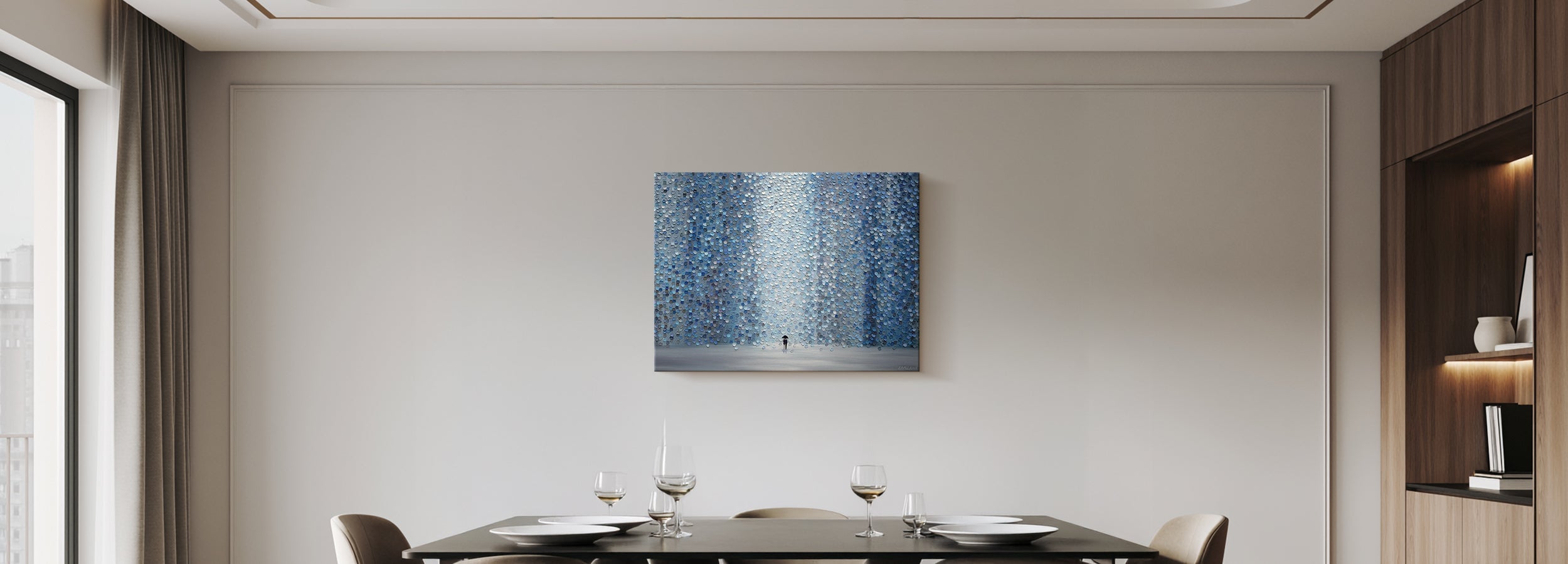
The piece a guest has to ask about — curiosity that lasts across a long dinner, not volume that overwhelms on the first glance.
Explore Conversation Art →
Elegant Classic
One serious piece that rewards a long look and tells the table the evening matters — refined, timeless, unhurried.
Explore Elegant Classic →
Italian Countryside
The long Italian lunch on your wall — a place you'd return to, not a vineyard logo. Travel warmth that opens a table.
Explore Italian Countryside →
Retro & Vintage
Nostalgia you can sit with — a vintage scene that carries history and starts a "remember when."
Explore Retro & Vintage →
Modern Farmhouse
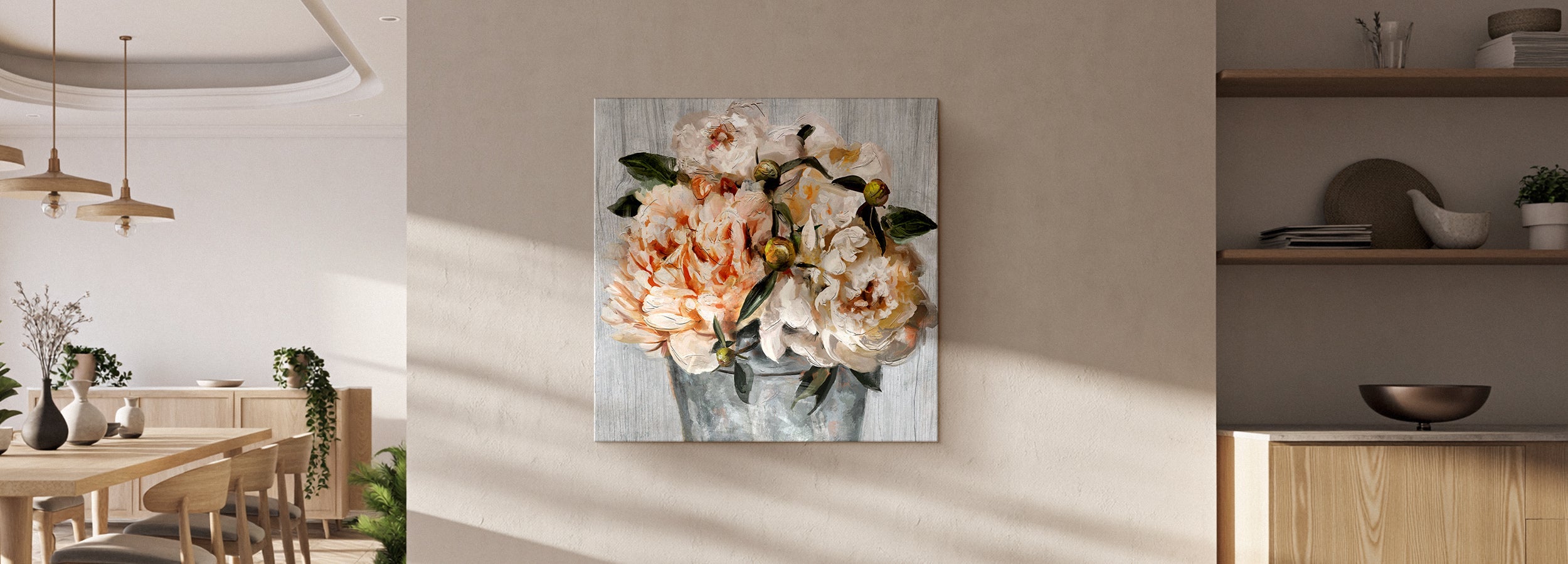
The relaxed welcome that loosens people and makes them stay — warm, soft, and unforced.
Explore Modern Farmhouse →Every piece is designed in California and hand-made to order in the size and format you choose — canvas, framed canvas, or framed print. Free U.S. shipping on orders over $100, 90-day hassle-free returns, and a 1-year warranty on every order.
Common Mistakes (and the Fix)
Theming it like a kitchen. Food and wine art belongs to the working room. In here it states the obvious — the food's already on the table. Fix: Reach for a place, a memory, or a mood instead.
Choosing art that says everything at once. A one-line piece is finished in a glance. Fix: Pick something with a second thing to say, so the wall is still interesting on the second hour.
Going too small over a long table. A single small frame strands on a dining wall. Fix: Size up to about two-thirds the table width, or hang a deliberate pair.
Hanging it too high. You view dining art seated — hang lower than feels natural so it meets people at the table, not above their heads.
Matching the art to the chairs. Don't decorate to the furniture. Fix: Choose to the evening you want, and let the art bring something the room doesn't already have.
Pieces That Set the Table
One piece from each dining style — five different ways to make people want to stay. Every piece is hand-made to order in the size and format you choose.


Every piece is designed in California and hand-made to order, backed by free U.S. shipping over $100, 90-day returns, and a 1-year warranty.
Shop the Dining Room CollectionFrequently Asked Questions
What kind of wall art is best for a dining room?
Art that shapes the experience around the table rather than matching the meal on it. The strongest dining pieces either open something — curiosity, a story, a place, a memory — or sustain the room with depth, warmth, and soft light. Decide what kind of evening you want people to have, then choose a piece that supports it. The one thing to skip is art that's fully legible in a glance; the dining room rewards work with a second thing to say.
Where should I hang art in a dining room?
The two natural spots are the focal wall the table anchors and the wall above a sideboard or buffet. Because you view dining art seated, hang it lower than you would elsewhere so it meets people at the table. Over a sideboard, keep the bottom of the piece roughly 6 to 10 inches above the surface.
How big should dining room wall art be?
Over a table, aim for about two-thirds the table's width — one generous piece, or a balanced pair or triptych. Above a sideboard, two-thirds to three-quarters the sideboard width. The most common error is going too small; on a dining wall, undersized art strands. When in doubt, size up.
How high should I hang dining room art?
Lower than usual, because the room is experienced seated. On an open wall, a center around 58 to 60 inches works; over a sideboard, measure from the furniture instead and leave roughly 6 to 10 inches of breathing room above it. The test is simple: it should feel right to someone sitting at the table, not just to someone standing in the doorway.
Should dining room art match my kitchen?
They don't need to match, because they do different jobs. The kitchen supports the person cooking; the dining room creates the experience for everyone seated. You can echo a color between the two for flow, especially in an open plan, but resist repeating the food-and-wine theme in both — the dining room does more when it reaches past the menu toward atmosphere.
Should I avoid food and wine art in the dining room?
You don't have to, but it's really a kitchen move. The food is already on the table, so literal food art tends to state the obvious. Art that reaches for a place, a memory, a beautiful light, or a moment of curiosity does far more to keep people gathered — which is the dining room's actual job.
In a dining room, the art has one job — give people a reason to stay at the table a little longer.


Leave a comment
This site is protected by hCaptcha and the hCaptcha Privacy Policy and Terms of Service apply.