

Maximalism Wall Art for Living Rooms
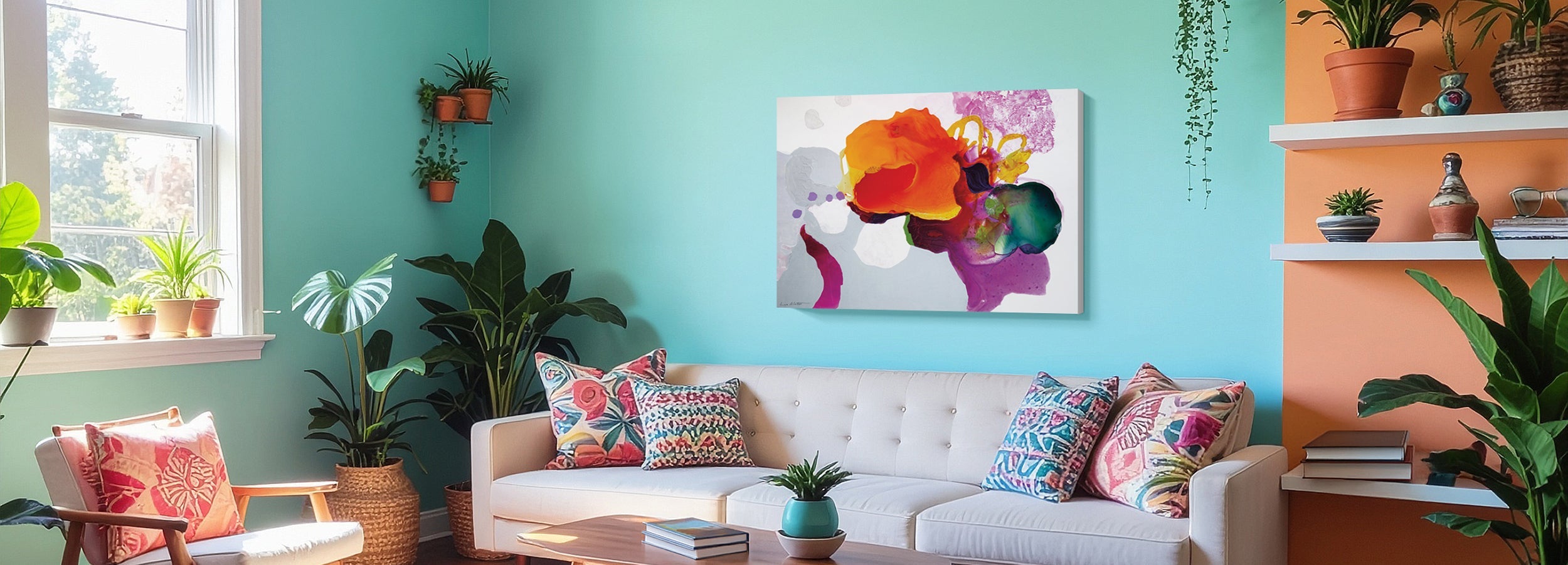
Maximalist living room wall art is layered, colorful, and abundant — but the rooms that work are abundant with order, never random. Set a controlling palette, anchor the wall with one large piece, repeat a color or motif, and balance the density with the occasional pause. Done right, more reads as rich and alive. Done without a plan, more just reads as noise. It’s the right style if you love a full, layered, characterful room and find bare walls cold.
A maximalist living room should feel full and alive — layered with color, pattern, and personality — without feeling like a jumble. The line between rich and chaotic is order: a palette and a rhythm running underneath the abundance. This guide is about holding that line.
Designed in California. Hand-made to order. Fine Art Canvas has been making canvas art since 1989, and every piece comes with free 90-day returns and a 1-year warranty.

At a Glance
- Abundance with order — more, but never random
- A controlling palette — ties the layers together
- Repetition: a recurring color, motif, or frame
- Balance: one large anchor among the many
- Everything relates — nothing is accidental
Maximalism is abundance with order — more, but never random. The mistake is reading “more is more” as “anything goes,” then stacking unrelated pieces until the wall becomes visual noise. Real maximalism is layered, but it’s governed: a controlling palette, a repeating motif, a sense of balance. Every piece relates to the others, even when there are a lot of them. That’s the difference between a room that feels gloriously full and one that just feels cluttered. The volume is the look; the order is what makes it work.
When Maximalism Is the Right Answer
Once you’ve decided which wall you’re filling — the Living Room Wall Art Guide covers that, starting with the wall, not the art — reach for maximalism when you want the room to feel rich, layered, and full of life rather than spare. It’s the natural fit for people with a lot to display, a love of pattern and color, and a sense that empty walls feel cold. People choose it because a minimal room feels unfinished to them — they want a space that’s full, personal, and unmistakably theirs.
How to Recognize It
You don’t need a design vocabulary to spot it. You’re probably looking at maximalism when:
The room is layered with color, pattern, and art — a lot, on purpose. There’s still a controlling palette and a sense of rhythm under the abundance. One large anchor piece holds the density together. And the fullness feels composed — rich and intentional, not piled up.
The tell is order inside the abundance. Great maximalism feels lavish; failed maximalism just feels like a jumble.
Is This Style Right for Your Home?
Maximalism Is Ideal If…
- You love a full, rich, layered room
- You have a lot of art and color to display
- You’ll commit to a controlling palette
- Bare walls feel cold and unfinished to you
Look at Another Style If…
- You want calm, open, breathing space
- You prefer one quiet, consistent palette
- Visual density overwhelms you
If a controlled mix sounds closer to your taste than full-on abundance, Bold & Eclectic is the lighter-touch version — the same energy with fewer pieces; and at the opposite end, Modern Minimalist trades abundance for one quiet, essential piece.
How to Use It Well in a Living Room
Set a controlling palette. Choose a family of colors and let everything live inside it. The palette is the invisible rule that makes a lot of pieces feel like one collection.
Anchor with one large piece. A single big work gives the eye somewhere to land and holds the density together. Without an anchor, abundance has no center.
Repeat a motif. A recurring color, shape, or frame threads through the layers and turns “a lot of things” into “a composed wall.”
Layer in groups, not at random. Build clusters that relate, then connect them, rather than scattering pieces evenly. Grouping reads as intention.
Leave one pause. Even a full wall needs a breath — a small gap or quiet piece keeps richness from tipping into chaos. Then get the anchor’s scale right: span about two-thirds to three-quarters of the sofa’s width, hung 6–10 inches above the back. The Living Room Wall Art Guide and our Wall Art Size Guide have the full method.
In a layered wall, the anchor sets the scale for everything else, so check it first. Use View in Your Room on any product page to see the exact artwork on your wall at true size, or tape out the dimensions and live with the outline for a day before you decide.
About Fine Art Canvas. Every piece in this guide is designed in California and hand-made to order. We’ve been making canvas art since 1989. Every order ships with free 90-day returns and a 1-year warranty — so you can see the piece on your wall before you commit.
Available as canvas, framed canvas, or framed print. Custom sizes available on most pieces.
Why These Six Pieces Work
A few from our Maximalism collection that are abundant but ordered — rich enough to layer, strong enough to anchor. Every piece is hand-made to order in your size and finish.

Bears and Monarchs
McKenna Kornowski

Freeway I
Cheryl Warrick

Ivory Coast
Nikki Chu

Across the Divide
Julia Purinton

Far Beyond Time
Cody Hooper

White Tiger Duet Black
Studio Arts
Common Mistakes (and the Fix)
Unrelated colors everywhere reads as a jumble. Fix: choose a color family and keep everything inside it.
With no anchor, the eye has nowhere to land. Fix: add one large, dominant piece.
Scattering pieces evenly looks accidental. Fix: build relating groups and repeat a motif.
No breathing room tips rich into chaotic. Fix: leave one deliberate pause.
More alone isn’t the style. Fix: maximalism is curation at volume, not just volume.
Every piece is hand-made to order in your chosen size and format.
Shop Maximalism Wall ArtFrequently Asked Questions
What is maximalist living room wall art?
It’s a layered, abundant approach — lots of color, pattern, and art on the wall — organized by a controlling palette and a sense of balance. The look is full and rich, but composed, so it reads as lavish rather than cluttered.
How do I keep maximalism from looking cluttered or random?
Give the abundance order. Set a controlling palette, anchor the wall with one large piece, repeat a color or motif, and leave one deliberate pause. The volume is the style; the underlying order is what keeps it from becoming noise.
What’s the difference between maximalism and eclectic?
They overlap, but maximalism is about volume with order — a lot of art, layered and governed by a palette. Eclectic is about mixing with a thread — different styles tied together, not necessarily a full wall. Maximalism can be eclectic, but it’s defined by abundance.
How big should the anchor piece be above the sofa?
Span about two-thirds to three-quarters of the sofa’s width and hang it 6–10 inches above the back, centered around 57–60 inches from the floor. In a layered wall, the anchor sets the scale everything else plays against. The Living Room and Size guides have the full method.
Is a gallery wall the same as maximalism?
A gallery wall is one way to do maximalism, but the two aren’t identical. Maximalism is the broader look of layered abundance; a gallery wall is a specific arrangement. Either way, a palette and an anchor keep it composed.
Does maximalism work in a small living room?
Yes — a small room can carry a lot of art if a controlling palette ties it together. Keep the palette tight and include one anchor, and density reads as rich and intentional rather than cramped.
Maximalism is abundance with order — more, but never random.


Leave a comment
This site is protected by hCaptcha and the hCaptcha Privacy Policy and Terms of Service apply.