
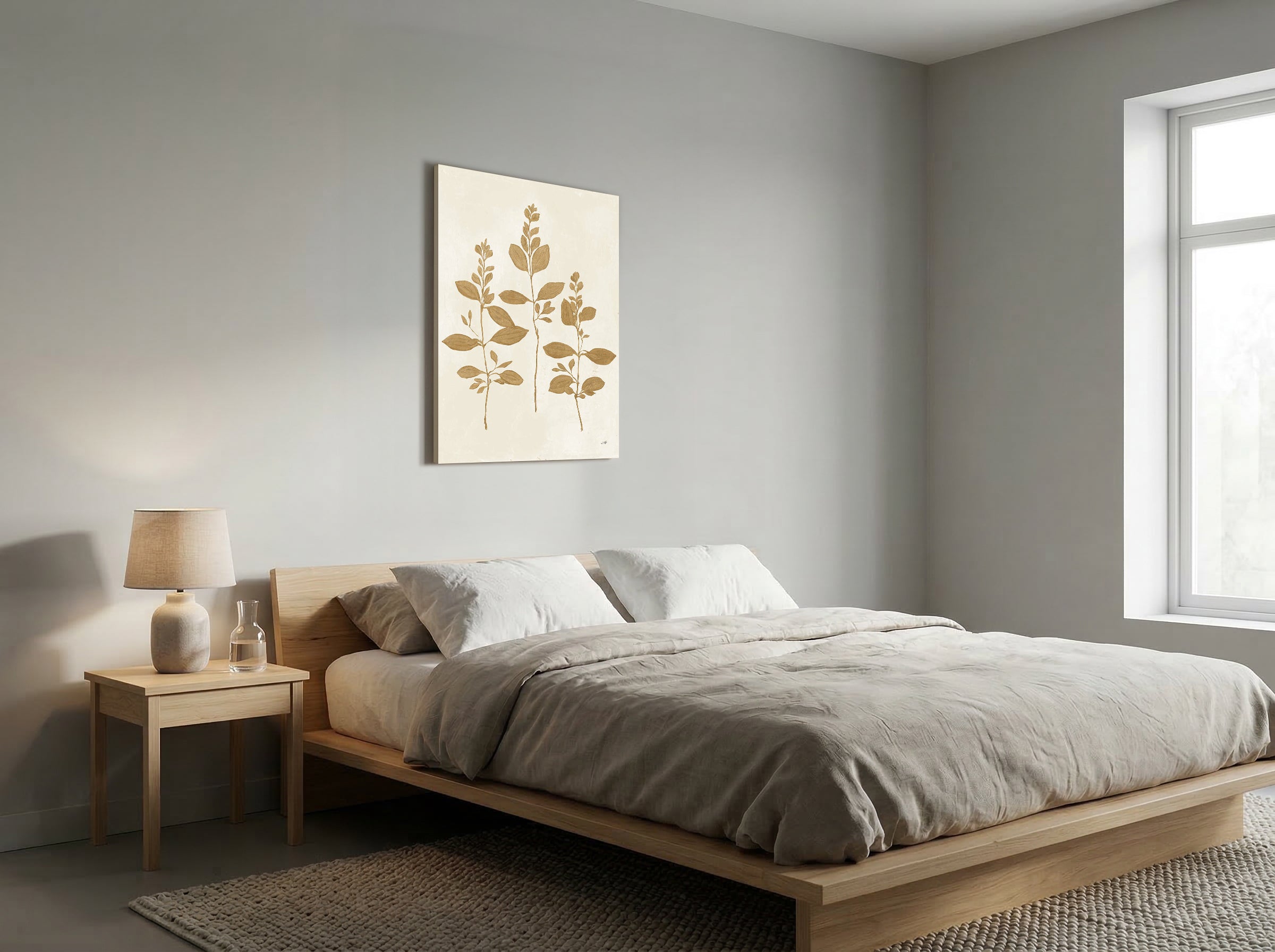
Simple Minimalist Guest Bedroom Wall Art
Yes, one piece of art is enough for a minimalist guest bedroom — as long as it’s a piece you actually chose, sized for the wall and hung with intention. A single, well-scaled piece reads as a completed decision. An empty wall, or three small pieces you weren’t sure about, reads as a room you didn’t finish. Minimalism isn’t about owning less. It’s about deciding fully.
One right piece isn’t bare — it’s decided.
- The feeling: calm, uncluttered, quietly finished
- The core move: one intentional piece, correctly scaled — not several tentative ones
- Best for: guest rooms that should feel restful and easy, with nothing for a visitor to decode
- Palette: soft neutrals, muted blues and greens, quiet contrast; color used sparingly and on purpose
- The trap to avoid: confusing restraint with incompleteness — leaving the wall bare because “less is more”
Here is the quiet fear behind almost every minimalist guest room: you hang one piece of art, step back, and wonder whether it looks intentional — or whether it just looks like you didn’t finish the room. So you hesitate. You add a second small piece, then a third, hedging your way toward “enough.” Or you leave the wall blank and tell yourself that’s what minimalism means.
Both roads lead to the same place: a room that feels unresolved. And in a guest bedroom, that matters more than usual, because you’re making the call on someone else’s behalf. Your guest can’t rearrange the wall. They simply arrive, look around, and either feel the room was thought through — or feel like they’re staying in a space that’s still half-done.
At Fine Art Canvas, we’ve been making canvas art since 1989. Designed in California. Hand-made to order. That means the question isn’t “how do I fill this wall?” It’s “which single piece do I want to commit to?” And because every piece comes with free 90-day returns and a 1-year warranty, committing to one piece carries no risk. This guide is about making that one decision with confidence.
Minimalism isn’t less — it’s decided
The most useful way to think about minimalist art is to stop counting pieces. Minimalism has almost nothing to do with how much is on the wall. It has everything to do with whether the choices feel complete.
A single large canvas over the bed can feel utterly finished. A wall crowded with small, uncertain frames can feel like a work in progress. The difference isn’t quantity — it’s conviction. Restraint reads as elegance when it looks deliberate, and as neglect when it looks accidental. The whole craft of a minimalist room is making restraint look deliberate.
So the real test of a minimalist guest room isn’t “is there enough here?” It’s “does every choice look like a choice?” When the answer is yes, one piece is plenty. Bare is the absence of a decision. Minimalist is a decision you can see.
When simple minimalist is the right answer
This style is the right call for a guest bedroom when you want the room to feel like a calm exhale — somewhere a visitor can set down their bag and immediately relax. It suits rooms that double as a home office or a reading nook, where visual quiet keeps the space from feeling busy. And it’s ideal when you want something that looks pulled-together without asking your guest to share your specific taste.
Minimalist art asks nothing of the person looking at it. With so few elements competing for attention, there’s simply nothing to decode — no in-joke, no personal photo, no busy scene to puzzle over. The quiet isn’t about the subject being familiar; it’s about there being so little on the wall to work out in the first place. That’s exactly why it works so well for guests — it welcomes without imposing.
How to recognize it
Simple minimalist art shares a few consistent traits. Once you can see them, choosing becomes much easier:
- Low visual noise. Few elements, generous open space, nothing competing for attention.
- Restrained color. Soft neutrals, muted blues and greens, or quiet tone-on-tone. When color appears, it’s a single deliberate note.
- Interest through texture, not clutter. Brushwork, subtle gradients, and depth give a quiet piece something to hold your eye — without adding busyness.
- Calm subjects. A single botanical, a soft landscape, an abstract in gentle tones. Nothing urgent.
The one decision that makes a piece look intentional
If minimalism is about deciding fully, then a minimalist guest room really comes down to one decision made well: choosing the piece, and then committing to it properly. Three things separate a piece that reads as decided from one that reads as unfinished. None of them is a matter of taste — they’re established interior-design conventions about scale and placement, and they’re what your eye is quietly responding to.
1. Scale it to the wall, not to your nerves
The single most common reason one piece looks “not enough” is that it’s simply too small. As a design rule, art over a bed or a feature wall should span roughly two-thirds to three-quarters of the furniture or wall width below it. Hit that proportion and a single piece anchors the whole wall. Fall short of it and even a beautiful piece floats, looking tentative — which is the exact feeling you were trying to avoid.
2. Hang it with intention
Center the piece at eye level — about 57 to 60 inches from the floor to the center of the artwork — and line it up deliberately with the bed or the wall below. Precise placement is what your eye reads as “someone decided this.” A piece nudged slightly off-center or hung too high is what reads as “this was temporary.”
3. Let texture carry the warmth
One piece shouldn’t have to warm the whole room by itself. Layer soft texture elsewhere — linen bedding, a knit throw, a wood nightstand — and the room reads as rich and considered even with a single artwork on the wall. This is the quiet secret behind rooms that look minimal but feel cozy: the art is decided, and the textures do the rest.
Get those three right and the “is one piece enough?” question answers itself. The piece stops looking like the only thing on the wall and starts looking like the thing the whole room was arranged around.
Is simple minimalist right for your guest room?
- You want the room to feel calm and effortless the moment a guest walks in
- You’d rather commit to one right piece than manage a busy wall
- The room does double duty and needs to stay visually quiet
- You want something that looks finished without revealing your personal taste
- You want the room to feel actively warm and welcoming — see Warm Welcome
- You want a current, of-the-moment look with a little more color — see Modern Refresh
- You love a layered, collected, gallery-wall feeling
- Soft neutral tone matters more to you than clean, spare composition — see Relaxed Neutral
If you’re deciding between styles: Modern Refresh shares the same instinct for intention but leans brighter and more contemporary — it’s about a room that looks current rather than one that looks spare. Relaxed Neutral is the closest cousin: where minimalist creates calm through clean composition, relaxed neutral creates it through soft, warm tone. And if you want the room to reach out to your guest rather than simply stay out of their way, Warm Welcome is the one to read next. When in doubt, start at the Guest Bedroom hub, which routes you to the right style by feeling.
How to use it well
Five moves turn “one piece of art” into a room that looks entirely resolved:
- Choose one hero, and mean it. Pick the single piece you respond to and let it own the wall. Confidence in the choice is what the room reads as.
- Size up before you size down. When torn between two sizes, go larger. Undersized art is the number-one cause of the “unfinished” look.
- Match the shape to the wall. A wide piece over a bed, a vertical on a narrow wall beside it, a square on a standalone stretch. The right orientation makes one piece feel inevitable.
- Keep the palette quiet, then allow one note. Let neutrals lead, and if you want a spark of color, let it come from a single deliberate piece rather than several.
- Support it with texture. Linen, wool, and wood around the room carry warmth so the single artwork never has to.
For exact dimensions by bed size and wall, see the Wall Art Size Guide. The short version: measure the wall, aim for two-thirds to three-quarters of its width, and center the piece around 57–60 inches from the floor.
| Where it hangs | Recommended piece | Best orientation |
|---|---|---|
| Above a queen or king bed | Wide single piece, 40–60″ across | Horizontal / panoramic |
| Above a twin or narrow wall | Single piece, 24–36″ across | Vertical or square |
| Standalone feature wall | One large piece, 30″+ across | Square or landscape |
Made to order, in your size. Designed in California. Hand-made to order. You choose the exact scale your wall needs — the surest way to make one piece look decided rather than bare. Backed by free 90-day returns and a 1-year warranty, making canvas art since 1989.
Why these six pieces work
Each of these proves a different way a single piece can carry a wall. Read them not as a shopping list but as six answers to the same question: what does “one decided piece” look like?

Blue Island
Mary Lou Johnson
The over-the-bed statement. Its wide, panoramic shape lets a single piece span the whole headboard wall — the clearest proof that one canvas can look completely finished.
Shop this piece ›
Botanical Study II Gold Navy
Julia Purinton
Restraint with a spark. Deep navy and a single note of gold prove that quiet doesn’t mean colorless — ideal for a narrow wall beside the bed.
Shop this piece ›
Traces Of Nature
Atelier Posters
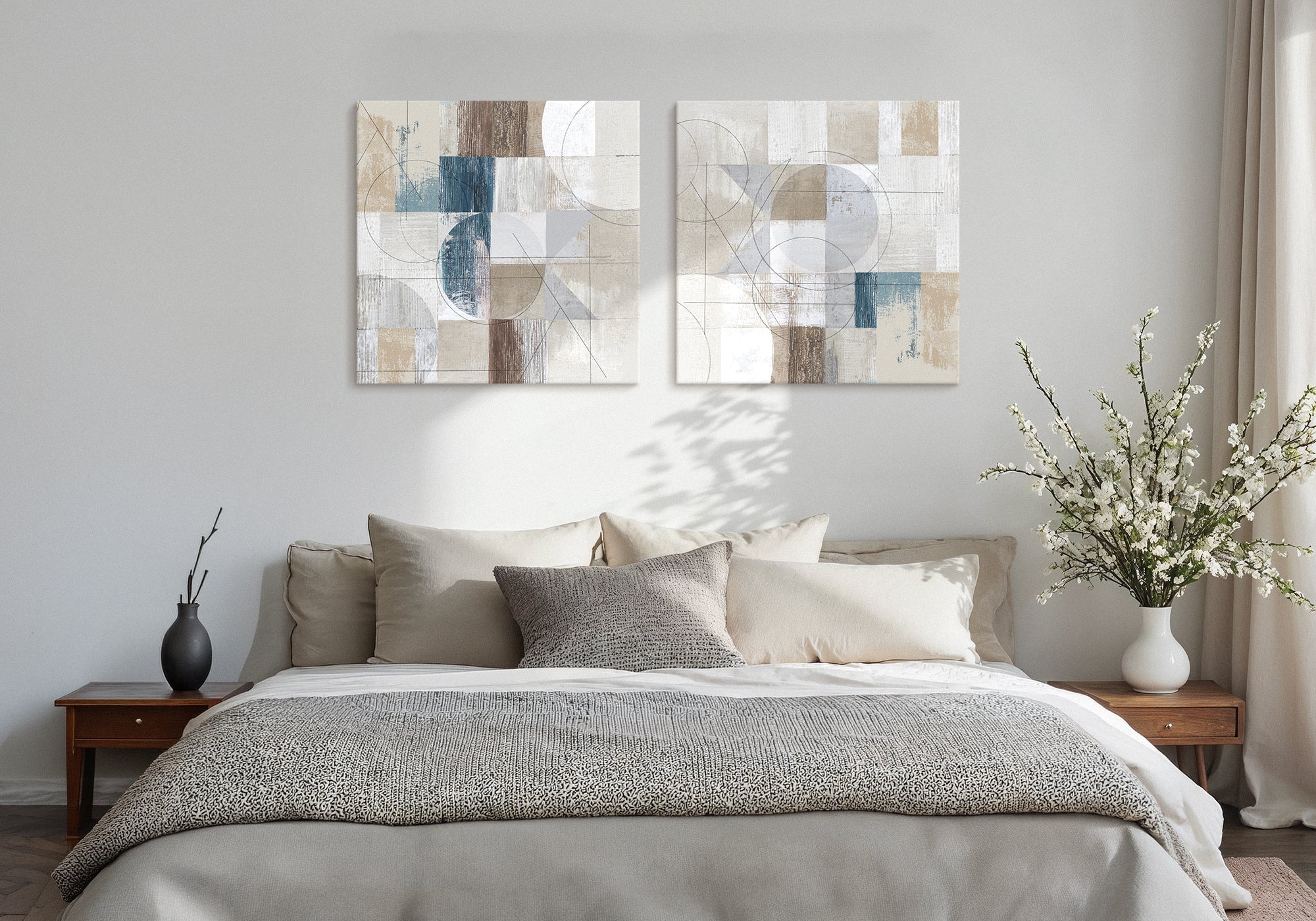
Texture as the interest. A square, tone-on-tone composition where depth does the work — one piece that never reads as flat or empty.
Shop this piece ›
Valley View
Julia Purinton
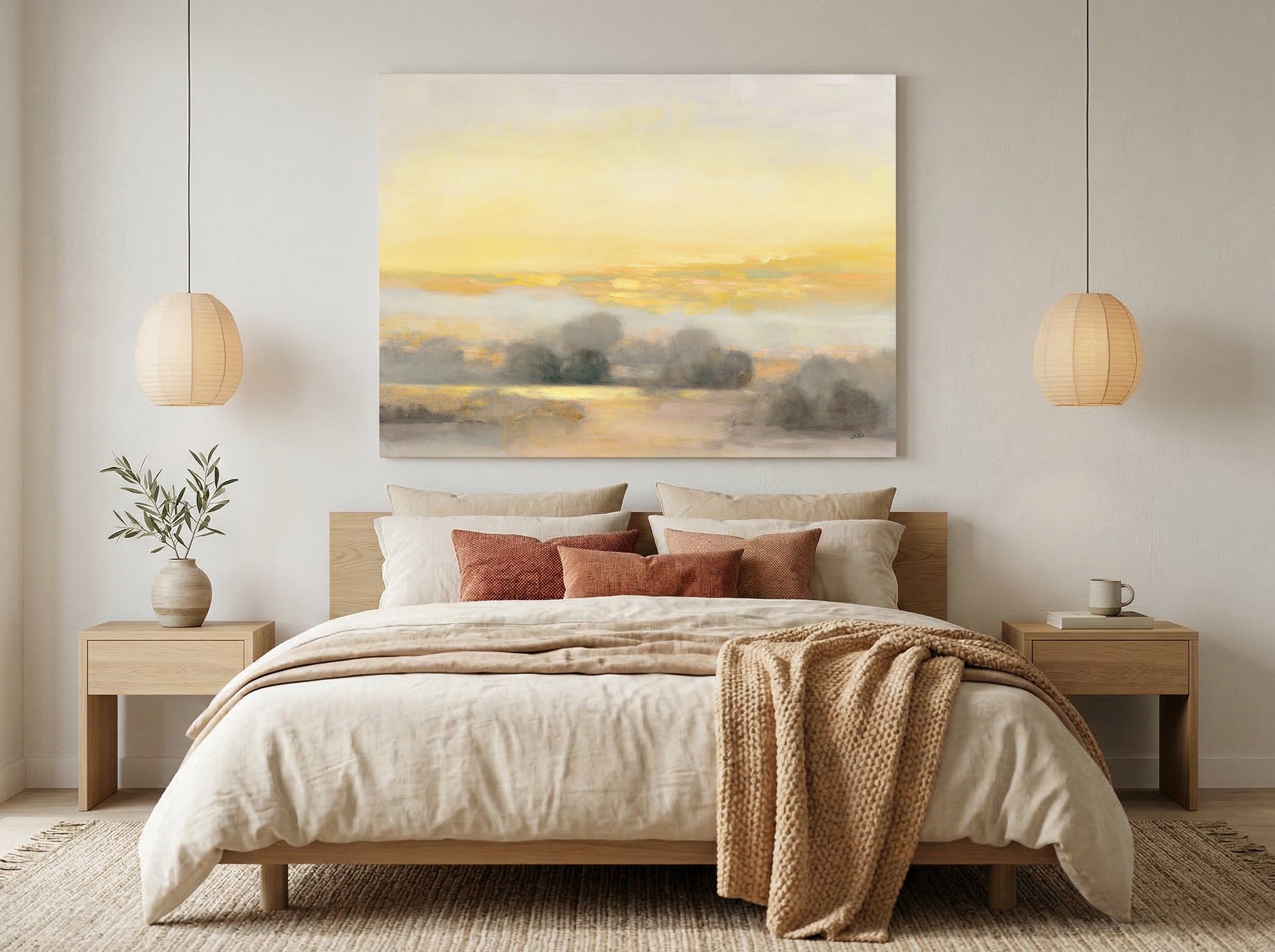
A single calming view. A soft landscape gives the eye one restful place to land — a natural focal point that anchors the room on its own.
Shop this piece ›
On My Own
Nathan Larson
Single-subject simplicity. One clear subject with room to breathe — the vertical piece for a narrow wall that needs one confident note, nothing more.
Shop this piece ›
Oceanside Meditation
Graffi*tee Studios
Mood over subject. A soft, near-abstract horizon that reads as pure calm — proof that a quiet piece can still be a firm decision.
Shop this piece ›See the full range in the Simple Minimalist Wall Art collection to find the one piece that fits your wall.
Common mistakes (and the fix)
Mistake: Hanging art that’s too small because a bigger piece feels like “too much.”
Fix: Scale to the wall. Two-thirds to three-quarters of the width below is what makes one piece look intentional instead of lost.
Mistake: Adding a second and third small piece to feel “safe,” which turns calm into clutter.
Fix: Commit to one hero. A single decided piece is the whole point — more pieces dilute it, they don’t reassure it.
Mistake: Leaving the wall bare and calling it minimalist.
Fix: Bare is the absence of a decision. Minimalist is a decision you can see. One right piece is the difference.
Mistake: Expecting the art alone to warm up a spare room.
Fix: Layer texture — linen, wool, wood — so the single piece adds focus while the room supplies the warmth.
Frequently asked questions
Is one piece of art enough for a guest bedroom?
Yes. One piece is enough when it’s chosen with intention and scaled correctly for the wall — ideally spanning two-thirds to three-quarters of the bed or wall width and centered around eye level. A single well-sized piece reads as a completed decision. What reads as “not enough” is usually a piece that’s simply too small, not a piece that’s alone.
Will a minimalist guest room look unfinished or bare?
Not if the choices look deliberate. The difference between minimal and unfinished is intention. A correctly scaled piece, hung with care and supported by soft texture in the bedding and furnishings, looks resolved. A too-small piece on a big blank wall is what looks unfinished — so the fix is scale and placement, not more art.
How big should the art be over a guest bed?
Aim for artwork that spans about two-thirds to three-quarters of the width of the bed below it, centered roughly 57 to 60 inches from the floor to the middle of the piece. Over a queen or king, that usually means a single wide piece 40 to 60 inches across. Because every Fine Art Canvas piece is made to order, you can choose the exact size your wall needs.
What kind of art works best for a minimalist guest room?
Calm subjects with low visual noise: a soft landscape, a single botanical, or a gentle abstract in restrained tones. Look for pieces that create interest through texture and composition rather than through busy detail or bright color. Neutral, quiet art also has the advantage of welcoming any guest without imposing a specific taste.
How do you keep a minimalist room from feeling cold?
Let texture and natural materials do the warming. Linen bedding, a knit throw, wood tones, and soft lighting add depth and coziness, so a single artwork can stay clean and quiet without the room feeling sterile. Minimalism gets its warmth from layered texture, not from adding more objects to the wall.
How many pieces of art should a guest bedroom have?
There’s no fixed number — but for a minimalist guest room, one well-chosen piece is often ideal. The goal isn’t a specific count; it’s that every choice looks decided. One intentional piece almost always serves a calm guest room better than several tentative ones.
Minimalism isn’t about owning less. It’s about deciding fully — and one right piece is a decision you can see.


Leave a comment
This site is protected by hCaptcha and the hCaptcha Privacy Policy and Terms of Service apply.