
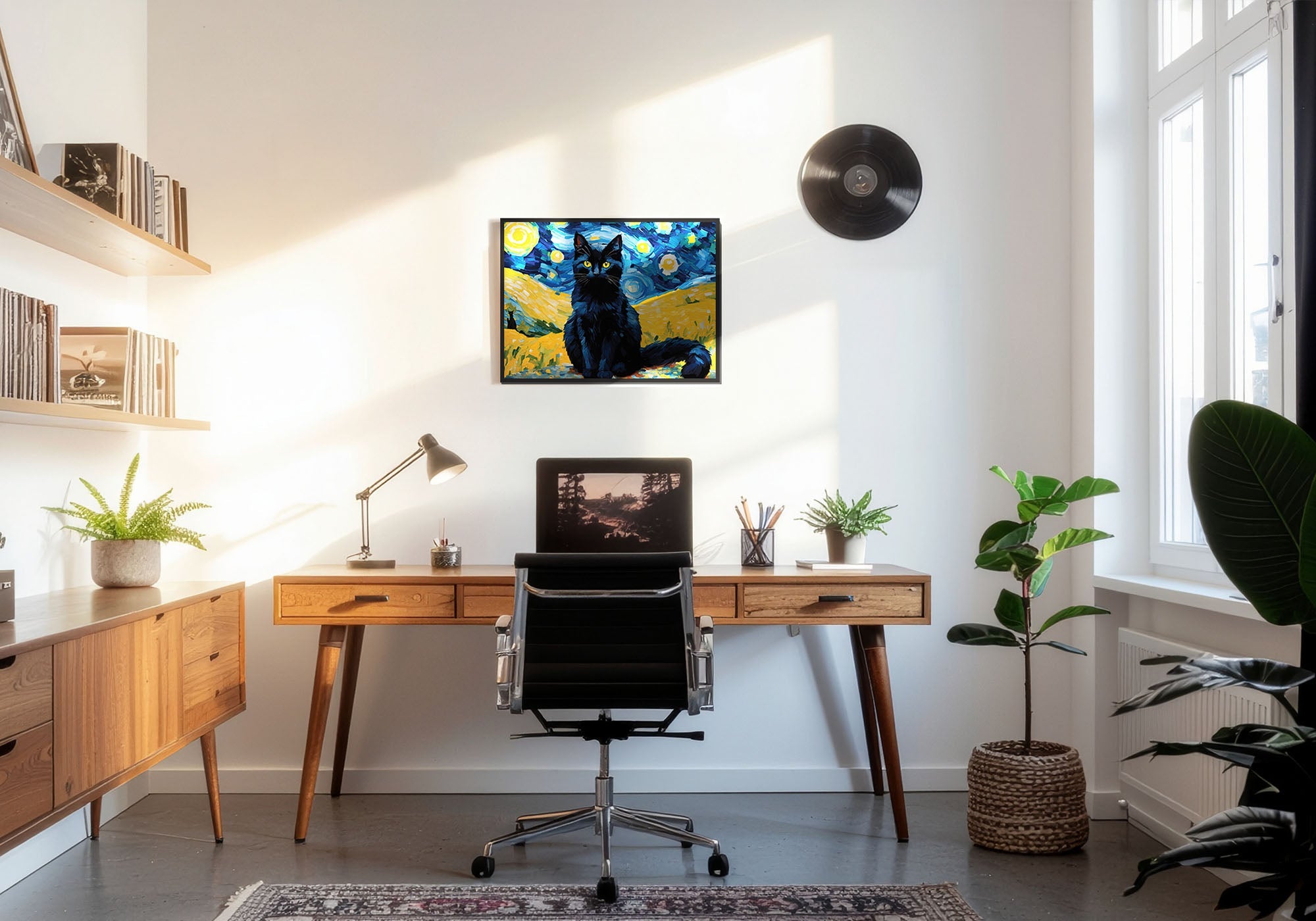
Creative Energy Home Office Art: When the Wall Should Inspire, Not Disappear
If your work is generative rather than sustained-focus — brainstorming, design, writing, problem-solving from scratch — a calm, low-stimulation wall is not necessarily the right wall. Visually rich, expressive art can support the kind of thinking that needs to wander before it lands.
The Home Office Advice That Only Fits Half the Workday
Most home office guidance, including the rest of this series, points toward reducing visual stimulation: calmer palettes, quieter compositions, fewer things competing for attention. That is well-supported advice — for sustained, directed-attention work. It is not the only kind of work that happens in a home office.
Generative work runs on a different engine. Brainstorming, early-stage design, drafting, and open-ended problem-solving do not benefit from narrowing focus onto one thing — they benefit from loosely associating between many things. A wall that disappears into the background does not give that process anything to bounce off.
Every piece from Fine Art Canvas is designed in California and hand-made to order — making canvas art since 1989, with free 90-day returns and a 1-year warranty.

At a Glance
- Style: Visually rich, expressive compositions — dynamic movement, multiple focal points, saturated color
- Best for: Generative, exploratory work — brainstorming, design, writing, early-stage problem-solving
- Look for: Pieces that genuinely move you, not just bright or complex ones — response, not stimulation
- Not for: Sustained, linear, focus-dependent work — that is Calm Focus
- Start with: 20″×24″ to 24″×36″ on the primary wall, in direct line of sight
When This Style Is Right for You
The most common mistake is applying “calm and minimal” advice to every home office, regardless of what kind of work happens there. Before choosing, name the actual cognitive demand.
If the work is sustained, linear, and focus-dependent — deep work that requires staying on one thread for long stretches — a highly stimulating wall works against you, not for you. That is exactly the territory Calm Focus art is built for.
If the work is generative — brainstorming, design, writing, open-ended problem-solving — visually rich art has a real evidentiary basis for supporting that kind of thinking.
If your actual driver is taste rather than task — you simply like bold, expressive work regardless of what kind of work you do — that is a legitimate reason on its own. The Abstract Modern collection is worth browsing for the same visual register without the functional framing.
How to Recognize It
There is a real, peer-reviewed basis for this distinction, and it is worth being precise about what it does and does not claim. A 2018 study by An and Youn, published in the Journal of Business Research, found that appreciating art brings about a feeling the researchers call inspiration — and that this inspired state measurably improved performance on creative tasks. The effect held up across several related studies, and was strongest for people open to aesthetic experience generally.
That is a real, traceable, peer-reviewed finding — not a vendor-blog statistic. It is also a single line of research, in a business and marketing context, not a large body of consensus science the way Attention Restoration Theory is for the Calm Focus collection. We are presenting it as exactly that: credible, specific evidence that visual art can support creative performance through inspiration — not a guarantee, and not license to claim any colorful piece will make you more creative.
Creative Energy vs. Calm Focus
| Quality | Creative Energy | Calm Focus |
|---|---|---|
| Composition | Dynamic, multiple focal points, movement | Single resting point, minimal complexity |
| Color | Saturated, varied, expressive | Muted, tonal, narrow range |
| Best suited to | Generative, exploratory, early-stage work | Sustained, directed-attention work |
| Mechanism | Inspiration → creative performance (An & Youn, 2018) | Attention restoration via natural imagery (ART) |
✓ This Style Is for You If
- Your work is generative — brainstorming, design, writing, open-ended problem-solving from scratch
- You think better when there is visual richness to bounce ideas off of
- You find that quiet, minimal walls feel stifling rather than calming during creative work
- You are drawn to expressive art that you genuinely respond to — not just “interesting” art
✗ Look Elsewhere If
- Your work is sustained, linear, and focus-dependent — try Calm Focus
- You want the room to feel organized and resolved — try Modern Productivity
- You want text-based art that connects to purpose — try Motivational
- You want bold geometry without figurative or expressive content — try Abstract Modern
The research ties the effect to inspiration, not simply to visual busyness. A piece that genuinely moves you — that you would stop and look at — is doing more for this purpose than one that is merely bright or complex. Choose for response, not just for stimulation level.
How to Use It Well
Unlike Calm Focus art, Creative Energy pieces are meant to be looked at directly, not allowed to fade into peripheral vision. Placement should put the piece somewhere you actually face during the part of your work that benefits from it.
- Primary wall, direct line of sight: if most of your work is generative, this piece can take the spot that Calm Focus advice would normally reserve for a quiet landscape.
- The wall behind your monitor, facing you: a piece you look up at between thoughts, not one that has to compete with what is on screen.
- Size: 20″×24″ to 24″×36″ works well as a single anchor piece. See the Wall Art Size Guide for room-specific sizing.
Made to order. Every Fine Art Canvas piece is designed in California and hand-made to order. Choose from gallery-wrapped canvas, framed canvas with a black floater frame, or framed fine-art prints with a slim white mat. Free 90-day returns and a 1-year warranty on every order.
Our Picks for Creative Energy Offices

Water Lilies And Japanese Bridge — Claude Monet
Shop this piece →

Abstract Sunrise — Osnat Tzadok
Shop this piece →

Beach Days — Randy Hibberd
Shop this piece →

Flora Re-Imagined II — Randy Hibberd
Shop this piece →

Abstract Reflections — Lisa Ridgers
Shop this piece →

Coastal Poppies — Danhui Nai
Shop this piece →
Common Mistakes with Creative Energy Art
Applying “calm and minimal” advice to every home office, regardless of what kind of work happens there. A wall designed to reduce stimulation is doing its job for someone doing focused, linear work — and quietly working against someone whose job is to generate new ideas.
Choosing for visual complexity rather than personal response. The research connects creative performance to the experience of inspiration — not to how many colors a piece has or how busy the composition is. A piece that genuinely moves you is doing more than one that is merely bright. Choose for response, not decoration.
Assuming Creative Energy art is just about taste. If your work is sustained, focus-dependent deep work, the research genuinely points the other direction — toward Calm Focus. The honest answer depends on what kind of thinking the room mostly needs to support, not on which wall looks more interesting.
Ready to find the right piece for your workspace?
Shop Creative Energy Office ArtFrequently Asked Questions
Is colorful or busy art bad for a home office?
Not universally — it depends on the kind of work the room needs to support. For sustained, focus-heavy work, visually quiet art tends to help. For generative, exploratory work like brainstorming or design, more visually rich art has real research behind it: a 2018 study found that art appreciation can produce a state of inspiration that measurably improves creative task performance.
What kind of art is best for a creative workspace?
Look for pieces with genuine visual richness — dynamic composition, varied color, expressive subject matter — that you find personally inspiring rather than simply busy. The research connecting art to creative performance is specifically about the experience of inspiration, not visual complexity for its own sake.
Should I choose Creative Energy or Calm Focus for my home office?
Name the kind of work you do most. If it is sustained, linear, and focus-dependent, Calm Focus art is the better-supported choice. If it is generative — brainstorming, ideation, early-stage creative or design work — Creative Energy art has a real evidentiary basis for supporting that kind of thinking.
Is there real research behind using art for creativity, or is this just a style trend?
There is a specific, peer-reviewed study worth naming directly: An and Youn (2018), published in the Journal of Business Research, found that appreciating art produces inspiration, which in turn improves performance on creative tasks. It is one study, in a business research context — not the scale of consensus evidence behind something like Attention Restoration Theory — but it is a real, traceable finding, not an invented statistic.
The right wall depends on the kind of thinking it needs to support. Calm walls help you stay on one track. Expressive walls help you find a new one. Most offices benefit from knowing honestly which kind of thinking they are equipped for.


Leave a comment
This site is protected by hCaptcha and the hCaptcha Privacy Policy and Terms of Service apply.