
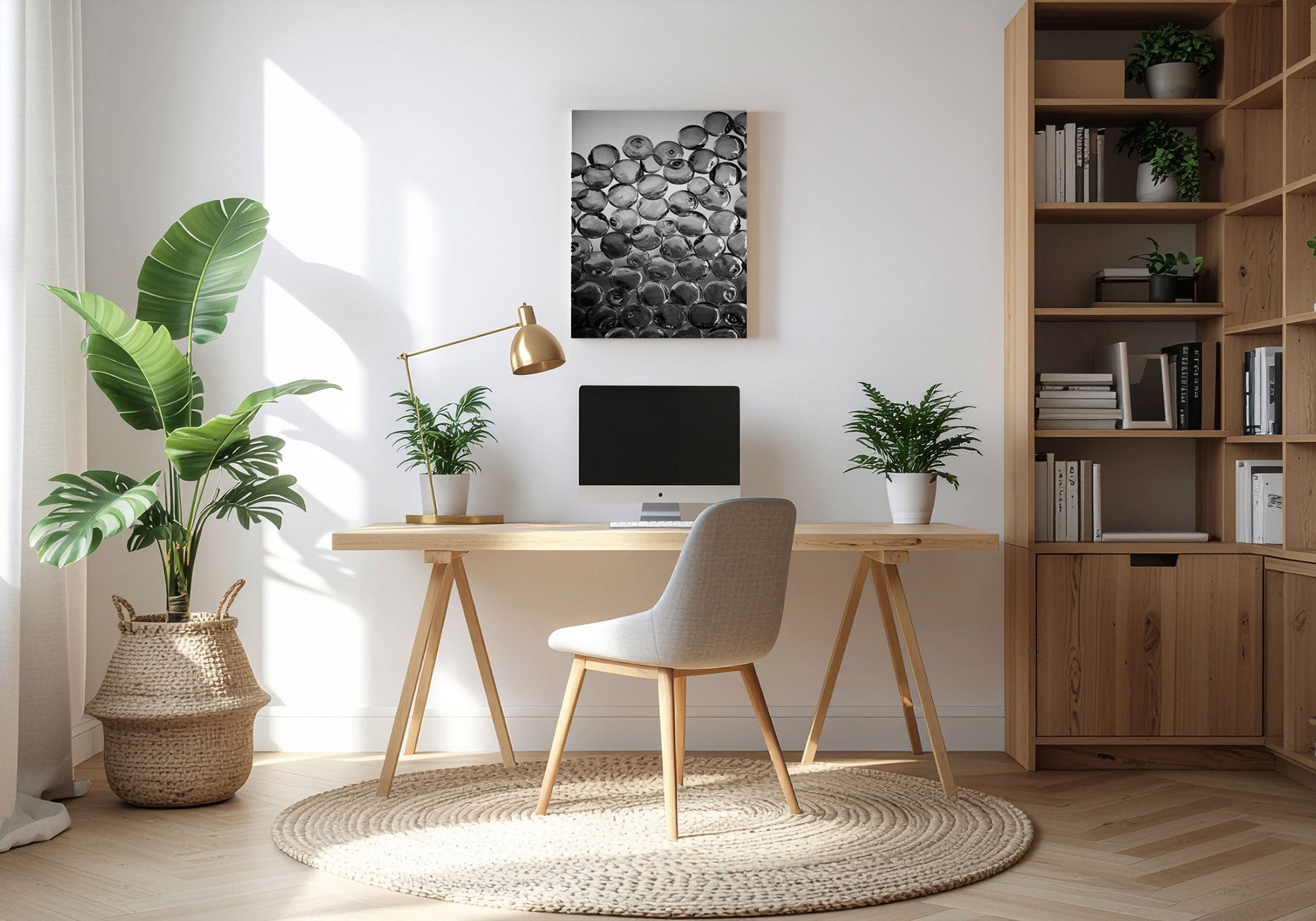
Calm Focus Home Office Art: The Wall That Gets Out of Your Way
For deep focus work, the most productive wall does not inspire you — it gets out of your way. Choose muted, nature-adjacent art with minimal composition. The goal is a wall that registers as present but disappears when you are working.
When people decide their home office needs to feel more focused, they often arrive at one of two conclusions: bare walls, or motivational art. The first feels clinical and airless. The second, while well-intentioned, often makes the problem worse.
Motivational slogans are high-contrast, text-heavy, visually active. Every time your eye lands on them, your brain processes language. That is the opposite of getting out of the way. And bare walls, while visually quiet, remove the sense of a room being inhabited — a quality that turns out to matter for sustained work.
Fine Art Canvas has been making canvas art since 1989. Every piece is designed in California and hand-made to order, with free 90-day returns and a 1-year warranty.

At a Glance
- Best for: Sustained, directed-attention work — reading, writing, analysis, code
- The mechanism: Attention Restoration Theory — natural imagery supports recovery of directed attention
- What to look for: Muted tones, nature-adjacent subjects, soft edges, no dominant focal point
- Placement: Primary wall, slightly above eye level — present but not demanding attention
- Not right for: Generative or creative work — see Creative Energy instead
Confusing “calm” with “empty.” A bare wall is not a Calm Focus wall. A bare wall is unfinished. A Calm Focus wall has presence — enough visual weight to feel deliberate — but no visual demands. The distinction is between a room that is settled and a room that is merely blank.
When Calm Focus Art Is Right for Your Office
The Calm Focus approach is a third option: art that gives the room enough visual weight to feel complete without generating the visual noise that pulls attention away from work. Choosing it deliberately — because you’ve noticed this is genuinely how you work, not because the category sounds right — is what makes it hold up over time rather than fading into the background of your attention along with everything else.
Why Nature-Adjacent Art Works for Focus
The pattern across Calm Focus art that actually works is nature-adjacent imagery: tree studies, soft forest views, botanical forms, quiet water. This connects to real research, not just a style preference.
Attention Restoration Theory — a well-established area of environmental psychology — has found that exposure to natural scenes specifically supports the recovery of directed attention after periods of sustained mental effort. This is specific, replicated research about natural imagery in particular. It is not evidence that anything “calm-looking” produces the same effect, and we want to be precise about that distinction rather than stretch the research further than it goes.
This is why a forest view outside a window tends to feel restorative rather than distracting. The right canvas, drawing on the same kind of natural imagery, can do a version of the same work.
✓ This Style Fits When
- Your work requires long, unbroken stretches of directed attention
- You find yourself craving a quieter room during focused work
- The room currently feels too busy or visually competitive
- You want the wall to settle into the room and disappear during work
✗ Look Elsewhere When
- Your work is primarily generative — brainstorming, ideation, design — see Creative Energy
- The challenge is disconnection from purpose, not distraction — see Motivational
- You simply want a bold, confident visual style independent of function — see Abstract Modern
Choose pieces where the eye can settle without finding a focal point that demands attention. A tree study where no single element dominates. A landscape where the horizon is soft rather than sharp. You want the visual equivalent of white noise — present enough to register, resolved enough to release.
What to Look For: The Qualities of a Genuinely Calm Piece
Not every quiet-looking piece functions as Calm Focus art. A few qualities distinguish pieces that actually work from pieces that merely appear serene in a thumbnail:
| Quality | Works for Focus | Works Against Focus |
|---|---|---|
| Tone | Muted, tonal variation within a narrow range (warm greens, soft grays, cool neutrals) | High saturation, strong complementary contrast |
| Composition | No single dominant focal point; the eye moves gently without being caught | Strong leading lines that draw and hold the eye; dramatic foreground subjects |
| Subject | Nature-adjacent: trees, water, botanical forms, quiet landscapes | Figurative scenes with implied narrative; faces; text |
| Edge quality | Soft to medium — edges that suggest rather than define | Sharp, high-definition edges that read as “look here” |
How to Use Calm Focus Art Well
Calm Focus art is most effective on the primary wall behind or beside the desk — the wall that occupies your peripheral field of vision during work, rather than the wall you look at directly. The goal is presence without demand.
Primary wall, slightly above eye level: the piece should sit at the upper edge of your resting gaze when seated, not at your direct eye line. This means the center of the piece at roughly 60–62 inches from the floor for most desk setups.
Avoid directly behind the monitor: even calm art placed directly behind a screen competes with it. Offset to one side, or hang above the monitor line.
One piece, not a gallery: the whole logic of Calm Focus art is reduction of visual complexity. A gallery wall of calm pieces is still a gallery wall.
Size: 20”×24” to 24”×36” on the primary wall. See the Wall Art Size Guide for help with specific dimensions.
If your office has a secondary wall that you see during breaks, this is an ideal location for one additional piece. A small landscape or tree study at 16”×20” on a wall you turn to when resting your eyes can function almost like a micro-restorative break.
About Fine Art Canvas. Every piece in this guide is designed in California and hand-made to order. We’ve been making canvas art since 1989. Every order ships with free 90-day returns and a 1-year warranty — so you can see the piece on your wall before you commit.
Available as canvas, framed canvas, or framed print. Custom sizes available on most pieces.
The Collection
These are the best-selling pieces from the Calm Focus collection, chosen because each one passes the settle-and-release test: present enough to give the room weight, quiet enough to stop demanding attention after the first look.

River Birch II
Carol Robinson

Into The Woods
Nan

Distant Forest
Julia Purinton

Tree Study
Nancy Crowell

Transformation
Mike Schick

Blue Silver Shore II
Sally Swatland
Shop the Calm Focus Collection
Applying “calm and minimal” advice to every home office, regardless of what kind of work happens there. If your work is primarily generative — brainstorming, ideation, early-stage design — a calm wall may genuinely work against you. See Creative Energy for the opposite approach, backed by different research.
Art that settles into the room so completely you stop seeing it — and can finally focus on the work.
Shop Calm FocusFrequently Asked Questions
What is calm focus art for a home office?
Calm focus art is wall art designed to give a workspace visual presence without generating visual demands. It uses muted tones, organic or nature-adjacent subjects, and minimal composition to create a settled visual environment — one that feels complete without pulling attention away from work. Tree studies, quiet landscapes, and soft botanical forms are the most common examples.
Does art in a home office actually affect focus?
For nature-specific imagery, yes — this is well-established by Attention Restoration Theory, which has found that natural scenes support recovery of directed attention after sustained mental effort. Beyond that specific finding, people simply differ in how much visual stimulation they want while working. If you regularly find yourself craving a quieter room, calmer and more minimally composed art is likely the better fit — not because of a single proven universal mechanism, but because it matches what you already know about how you work best.
Should home office art be colorful or neutral?
For a Calm Focus office, the most effective palette is tonal rather than chromatic — color variation within a narrow, muted range rather than strong or saturated hues. Soft greens, warm grays, cool blues, and earthy neutrals all work. The key is narrow tonal range and low saturation, not any specific color.
Is landscape art good for a home office?
Yes — quiet landscape art is one of the most effective categories for a Calm Focus office. Look for landscapes with soft horizons, muted palettes, and no dominant foreground subject demanding attention. Avoid dramatic skies, strong compositional diagonals, or highly saturated colors even in landscape form.
Can I have more than one piece of art in a calm focus office?
You can — but approach it carefully. A gallery wall reintroduces visual complexity even if every piece is individually calm. If you want more than one piece, keep the palette tightly unified and limit to two pieces maximum. One quiet landscape on a break-facing wall and one larger calm piece on the primary wall is a better approach than a gallery arrangement.
The most productive wall in a home office is not the most inspiring one. It is the one that settles into the room so completely that you stop seeing it — and can finally focus on the work.


Leave a comment
This site is protected by hCaptcha and the hCaptcha Privacy Policy and Terms of Service apply.