
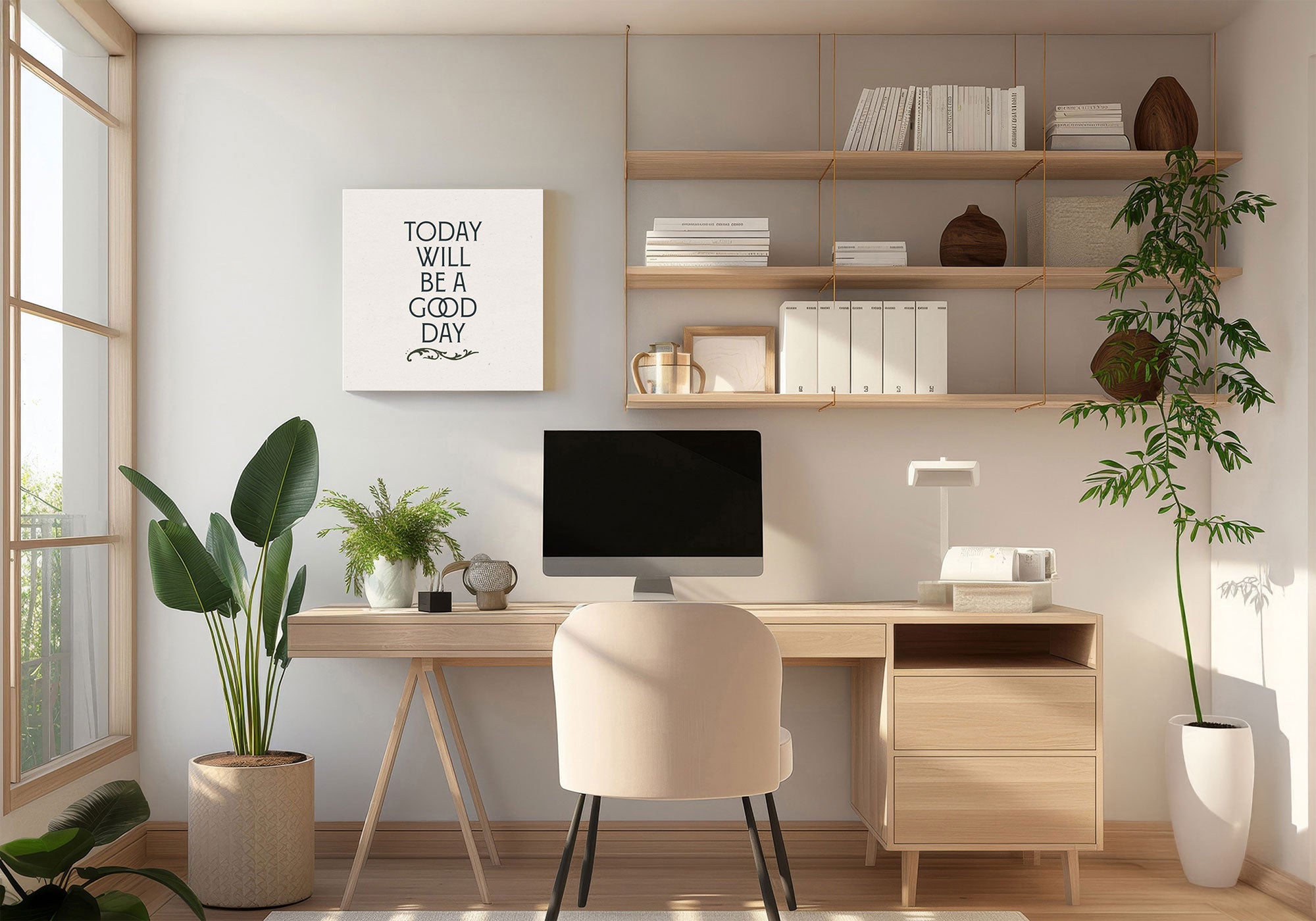
Motivational Office Wall Art: Remind, Don't Shout
The best motivational office art does not tell you to work harder. It reminds you, quietly, what the work is for. Choose pieces that connect to purpose — not to effort — and place them where you look during breaks, not during work.
Why Most Motivational Art Stops Working by Week Three
Search for motivational office art and you will find two categories dominating the results: hustle-culture slogans (Rise and Grind, Work Hard Play Hard, Stay Humble Hustle Hard) and aspirational lifestyle imagery. Both categories share the same underlying assumption: the problem is insufficient motivation, and the solution is a louder reminder to try harder.
This model misunderstands what motivation actually is and how it sustains over time.
The category of motivational art worth putting on a wall is smaller and more specific than the market suggests. These are pieces that work by connection rather than instruction. They remind, rather than shout. And they meet you on a hard Wednesday afternoon — not just on a fresh Monday morning.
Every piece from Fine Art Canvas is designed in California and hand-made to order — making canvas art since 1989, with free 90-day returns and a 1-year warranty.

At a Glance
- Style: Purpose-driven pieces that connect to meaning, not effort — quiet, confident, grounded
- Best for: Offices where disconnection from purpose is the real challenge, not distraction or focus
- Look for: Art that reminds you why you do the work — not that you should do more of it
- Not for: Attention or focus challenges — that is Calm Focus
- Placement: Secondary wall — where you look during breaks, not in the primary field of vision during work
When This Style Is Right for You
The most common mistake in choosing motivational art is diagnosing the wrong problem. Before choosing, name the actual challenge in your office.
If the challenge is distraction, interruption, or difficulty staying in deep focus: motivational art will not help and may make it worse. The challenge is attentional, not motivational. Start with Calm Focus art that reduces visual noise.
If the challenge is disconnection from purpose: this is a genuine motivational challenge, and a well-chosen piece can address it. The work is meaningful; the room should reflect that.
If the challenge is low energy across a long day: placement matters more than piece choice. A motivational piece positioned where you see it during a mid-afternoon break will do more than the same piece staring at you for eight hours.
How to Recognize It
Psychologists distinguish between two fundamentally different motivational orientations. Extrinsic motivation responds to external rewards and pressures — recognition, performance, the fear of falling behind. Intrinsic motivation is driven by the work itself: its meaning, its challenge, what it connects to in the person doing it.
This distinction comes from established psychology, not from research about art specifically. We are applying a real framework to a new context, not citing a study about wall art — and that is worth being honest about. What it explains is genuine: why certain motivational messaging holds up over years and other messaging fades within weeks.
Hustle-culture slogans activate extrinsic motivation. This is real and useful — but it is also the type of motivation that exhausts. It is hard to sustain over years without something deeper underneath it.
Intrinsically oriented art activates a different register. "Do What You Love" is not telling you to produce more. It is pointing at the relationship between the person and the work itself. "Some Work in Acres, Not Hours" is not about hustle — it is a frame for understanding the kind of patient, cumulative effort that produces something real over time. That is a different quality of motivation, and it proves more durable.
What Distinguishes Motivational Art That Works
| Quality | Works over Time | Loses Power Quickly |
|---|---|---|
| Message type | Connects to purpose, meaning, or the nature of the work itself | Instructs effort: "hustle," "grind," "work harder" |
| Specificity | Oblique or particular — could not belong to any office | Generic — could appear in any workspace, in any industry |
| Tone | Quiet, confident, grounded | Urgent, loud, declarative |
| Placement | Where you look during breaks — not during work | Primary field of vision during focused work |
✓ This Style Is for You If
- You feel disconnected from why the work matters — not from the work itself
- You want a piece that earns your attention on a hard day, not one that demands it every day
- You respond to quiet, oblique reminders rather than loud, declarative instructions
- You can complete the sentence "This reminds me that…" with something personal to your work
✗ Look Elsewhere If
- Your challenge is staying focused or avoiding distraction — try Calm Focus
- You want the room to have clear visual structure, not a message — try Modern Productivity
- You prefer atmospheric, expressive art over text-based pieces — try Creative Energy
- You want bold geometric patterns for a modern workspace — try Abstract Modern
Before choosing a motivational piece, complete this sentence: "This reminds me that…" If the answer is "I should work harder," it is an extrinsic piece — useful for short bursts, not for the long game. If the answer is something personal to why you do the work, it is an intrinsic piece. Those are the ones that last.
How to Use It Well
Placement is the detail that most motivational art advice gets wrong. The instinct is to put it where you will see it constantly — directly ahead, in the primary field of vision. This is exactly where it should not go.
Text-based or narratively active art placed in the primary field of vision during focused work creates a specific kind of low-level distraction. The brain processes language automatically. Every time the eye moves toward a piece with text, some small portion of attention goes to parsing it. The piece intended to motivate you begins to slow you down.
The right placement for motivational art is where you look when you are not working:
- The wall you face when you stand up or stretch: a natural break point, a natural moment for a piece to do its work.
- Above the door to the office: you see it when you leave and when you enter.
- On a side wall at the edge of peripheral vision: present but not demanding.
- Not directly behind the monitor, not in the center of the primary wall.
One well-placed motivational piece is almost always more effective than two. The goal is a piece that earns attention at the right moment — not one that competes for attention at every moment. See the Wall Art Size Guide for sizing guidance.
Made to order. Every Fine Art Canvas piece is designed in California and hand-made to order. Choose from gallery-wrapped canvas, framed canvas with a black floater frame, or framed fine-art prints with a slim white mat. Free 90-day returns and a 1-year warranty on every order.
Our Picks for Motivational Offices

Some Work in Acres, Not Hours
Shop this piece →

Climb Every Mountain
Shop this piece →

Do What You Love
Shop this piece →

Adventure Awaits
Shop this piece →

Expensive Things
Shop this piece →

Beauty of Dreams
Shop this piece →
Common Mistakes with Motivational Art
Choosing motivational art that addresses effort rather than meaning. Slogans that say "work harder" function well as a jolt on Monday morning — and stop working by Wednesday afternoon. Art that reminds you why you are doing the work addresses the cause, not the symptom. That distinction is the difference between a three-week piece and a piece that still matters in year three.
Placing motivational art in the primary field of vision during focused work. Text-based art directly ahead creates low-level distraction because the brain processes language automatically. Every time the eye moves toward a piece with text, some small portion of attention goes to parsing it. Place motivational art where you look during breaks — the wall you face when you stand up, beside or above a door, at the edge of peripheral vision.
Hanging multiple motivational pieces in the same room. One well-placed piece that earns attention at the right moment is almost always more effective than two or three competing for attention at every moment. If the message needs to be louder, the problem is not volume — it is the wrong message.
Ready to find the right piece for your workspace?
Shop Motivational Office ArtFrequently Asked Questions
What makes good motivational wall art for an office?
Good motivational office art connects to purpose rather than instructing effort. Pieces that remind you what the work is for sustain motivation over months and years. Pieces that tell you to work harder provide a short-term boost and lose power quickly. The test: complete the sentence "This reminds me that…" If the answer is personal and specific to why you do your work, the piece has staying power.
Should motivational art be in the main field of vision in a home office?
No — this is the most common placement mistake. Text-based art placed directly in the field of vision during focused work creates low-level distraction because the brain processes language automatically. Motivational art works best where you look during breaks: the wall you face when you stand up, beside or above a door, or on a side wall at the edge of peripheral vision.
What is the difference between motivational and inspirational office art?
The distinction worth making is between art that instructs and art that connects. Hustle-culture motivational art instructs: it tells you to work harder. Genuinely inspirational art connects: it points at something true about the nature of effort, purpose, or meaning. Look for pieces where the message is oblique, personal, or specific to the kind of work you do.
Can motivational art and calm art coexist in the same office?
Yes — and this is often the best arrangement. Keep the primary wall as Calm Focus art: minimal, settled, non-demanding. Place one motivational piece on a secondary wall that you turn to during breaks. The two serve different moments in the workday and do not compete.
How do I know if I need motivational art or calm focus art in my office?
Name the actual problem. If you lose focus or get distracted easily, the challenge is attentional — Calm Focus art addresses it. If you feel disconnected from why the work matters, the challenge is motivational. Many offices need both: one calm piece on the primary wall and one purposeful piece on a secondary wall.
The best motivational piece in any office is the one that earns your attention on a hard day — not the one that demands it every day. Remind, do not shout. Connect, do not instruct.


Leave a comment
This site is protected by hCaptcha and the hCaptcha Privacy Policy and Terms of Service apply.