
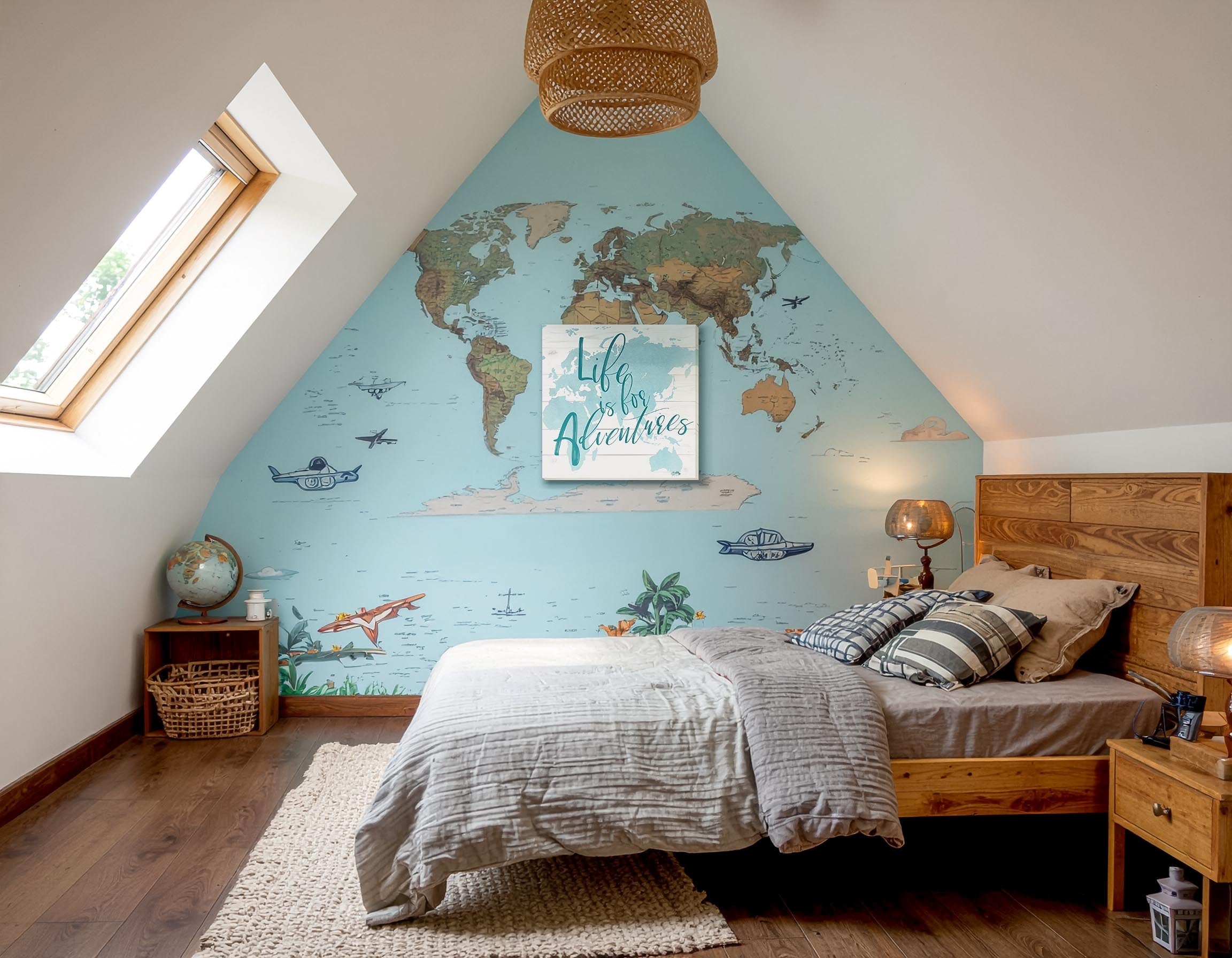
Adventure & Imagination Wall Art for Kids
For the child who's endlessly curious about the world, the best art shows the real world: a true mountain, a real forest, an actual far-off place — not generic "adventure" clip-art with arrows and slogans. A real landscape makes a child wonder what's over the ridge; the word "ADVENTURE" on a wall just decorates. Choose a real place or a real wonder, hang it where they play and plan, and the room becomes a window instead of a poster.
You're designing for a child who's endlessly curious about the world. The goal here is to feed that curiosity with real places and real wonders — not a generic theme of adventure.
Some kids want to know what's over the next hill. They ask where rivers go, how tall the mountain is, what lives in the deep part of the lake. For that child, the wall can do real work: it can point outward. The trick is choosing art that actually sparks the wondering — and that's almost always a real place over a packaged "adventure" look.
Every piece is designed in California and hand-made to order by Fine Art Canvas, making canvas art since 1989. Free U.S. shipping over $100, 90-day returns, and a 1-year warranty on every order.

Adventure & Imagination — At a Glance
- Best for: The explorer — the child who's curious about the real world and wants to see all of it
- Mood: Open, expansive, quietly inspiring
- Palette: Natural — sky blues, forest greens, mountain neutrals, warm earth
- Subjects: Mountains, forests, oceans and lakes, maps, the night sky, real animals, far-off places
- Avoid: Generic "adventure" clip-art — arrows, compasses, "ADVENTURE AWAITS" slogans
When Your Child Is Curious About the World
Reach for this when the child's defining trait is curiosity about real things — the outdoors, animals, maps, weather, where places are and what's in them. This isn't the dreamer who invents worlds; it's the explorer who wants to understand this one. The art's job is to keep that window open: to put something on the wall that rewards a long look and raises a question. A child who grows up with a real mountain over the desk has been quietly invited, every day, to wonder what it would be like to climb it.
Why Real Places Beat a "Theme"
The adventure aisle is full of decorated nouns — arrows, mountains flattened into logos, the word ADVENTURE in a bold font. It looks the part, but it doesn't do anything. A real landscape does. Here's the difference worth remembering:
A theme tells; a place invites. "Adventure awaits" announces a mood. A real forest makes a child ask what's deeper in. One decorates a wall; the other opens a door.
Real ages better. A genuine mountain or ocean scene still looks right when the child is twelve. A cartoon-compass "adventure" set ages out with the nursery.
Specific beats generic. A particular place — this lake, that range, those tropics — gives the imagination something real to hold. Generic gives it nothing.
✓ This Is Your Child If…
- They're curious about the real world — the outdoors, animals, maps, far-off places
- They ask how things work and where things are
- You want the room to point outward and feed that wonder
✗ Consider Another Route If…
- They live in invented worlds more than the real one — see Storybook & Whimsical
- They want to understand how things work — see Educational
- The room's first job is sleep — see Gentle & Calm
Five Moves for an Explorer's Room
1. Choose a Real Place, Not a Slogan
A true mountain, forest, coastline, or far-off scene does the wondering work that a word never will. If a piece's main feature is text, keep looking.
2. Pick Somewhere Worth Wondering About
A specific landscape — a particular range, a real shoreline — gives curiosity something concrete to chew on. The more real the place, the more questions it raises.
3. Let the Outdoors Feel Big
Scale is part of wonder. Give a landscape room to breathe and feel expansive rather than cropping it small — an explorer's wall should feel like a window, not a postcard.
4. Pair a Map with the Real Thing
A handsome map next to a real landscape says, in effect, "here's the world — go see it." Together they invite both the planning and the dreaming.
5. Hang It Where They Plan and Play
Over the desk, the reading spot, or the play zone, near a child's eye level — so it sits in their daily line of sight and keeps the question alive.
Size it right: aim for a piece — or a grouping read as one shape — that spans about two-thirds to three-quarters of the bed, desk, or wall below it, centered roughly 57 to 60 inches from the floor (a little lower over a child's desk). For exact measurements, see the Wall Art Size Guide.
Every piece is designed in California and hand-made to order on gallery-wrapped canvas — lightweight, with no glass to worry about. Free U.S. shipping on orders over $100, 90-day hassle-free returns, and a 1-year warranty on every order.
Real-World Pieces to Start From
Six pieces that point outward — mostly real places and nature, plus one playful expedition to show that wonder can have a sense of humor too.


Common Mistakes (and the Fix)
Buying the "adventure" look instead of a place. Arrows, compasses, and "ADVENTURE AWAITS" lettering decorate a wall but spark nothing. Fix: Choose a real mountain, forest, or shoreline and let it do the wondering.
Going tiny with a landscape. A big outdoors shrunk to a small frame loses the very thing that inspires — scale. Fix: Give it room to feel expansive.
Defaulting to "boy stuff." Curiosity about the world isn't a gender. Fix: An explorer can be any child; choose by the wonder, not the aisle.
Over-theming the room. A wall-to-wall expedition set leaves no room to breathe. Fix: One strong landscape, maybe a map, and you're done.
Going too small overall. The most common sizing error. Fix: Size up to two-thirds of the furniture or wall below.
Every piece is designed in California and hand-made to order. Find the real place that sparks wonder.
Shop Adventure & ImaginationYour Questions, Answered
What's the best adventure art for a kid's room?
Real places and real nature over generic "adventure" graphics. A true mountain, forest, coastline, or far-off scene invites a child to wonder and keeps working for years; arrows-and-slogans adventure art decorates the wall but inspires little and dates fast.
Is adventure art just for boys?
No. Curiosity about the world isn't a gender — plenty of girls want the mountains, the maps, and the wild animals, and plenty of boys want something else entirely. Choose by the child's actual interest, not by the label on the collection.
How is adventure art different from educational art?
Adventure art inspires wonder — it makes a child want to go and see. Educational art explains — it helps a child understand how things work. Pick by what your child is after: the feeling of the world, or the workings of it. Many curious kids happily want both.
Will mountain and nature art still work as my child grows?
Beautifully. Real landscapes are among the most age-proof art you can hang — a forest or coastline reads as sophisticated by the teen years, where a cartoon-adventure theme would have aged out long before.
Are maps a good choice for a kid's room?
Yes — a handsome map invites curiosity and grows with a child, especially paired with a real landscape. Choose an attractive, real-world map over a cartoon one, and it earns its place from preschool through high school.
What size should go over a bed or desk?
Aim for a piece, or a grouping read as one shape, that spans about two-thirds to three-quarters of the width of the bed, desk, or wall below it, centered around 57 to 60 inches from the floor — a little lower over a child's desk so it sits at their level.
A real mountain sparks more wonder than the word "adventure" ever could — choose the world itself, not a theme of it.


Leave a comment
This site is protected by hCaptcha and the hCaptcha Privacy Policy and Terms of Service apply.