
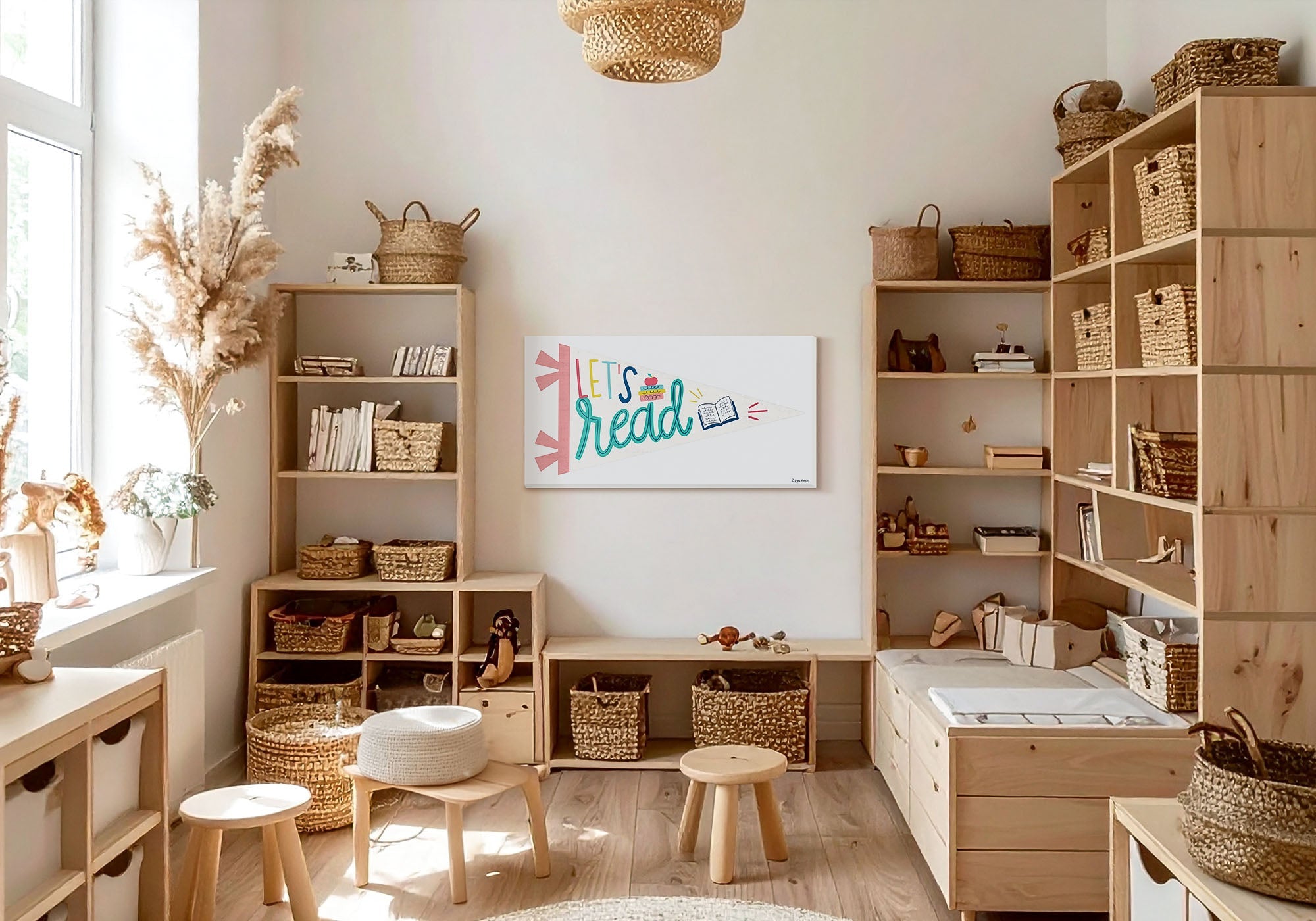
Educational Wall Art for Kids
For the child who loves discovering how things work, the best educational art sparks a question rather than delivering a lesson. A star map, a patent drawing, a world map, a beautiful alphabet — these invite a child to wonder and ask. The mistake is turning the bedroom into a classroom: a wall of flashcards teaches nothing a child wants to learn. Lead with curiosity, keep the literal teaching pieces to one, and the room stays a bedroom that happens to make a kid think.
You're designing for a child who loves discovering how things work. The goal here is to feed that curiosity — without turning the bedroom into a classroom.
Some kids take the remote apart to see what's inside. They ask why the sky is dark at night, how the letters make words, where the airplane is going. For that child, the wall can keep the questions coming — but only if it invites curiosity rather than drilling facts. The difference between art that teaches and art that lectures is the whole job here.
Every piece is designed in California and hand-made to order by Fine Art Canvas, making canvas art since 1989. Free U.S. shipping over $100, 90-day returns, and a 1-year warranty on every order.

Educational — At a Glance
- Best for: The curious learner — the child who asks how and why, and takes things apart to find out
- Mood: Curious, bright, quietly clever
- Palette: Clean and warm — not primary-color classroom brights
- Subjects: Maps, the night sky and space, patents and diagrams, the alphabet and language, the natural world
- Avoid: A wall of flashcards — the bedroom turned into a classroom
When Your Child Loves How Things Work
Reach for educational art when the child's engine is curiosity about how the world actually works — the mechanics, the systems, the names of things. This is the kid who wants to understand, not just to wonder at. The art's job is to keep that drive fed: to put something on the wall that quietly rewards a question with another question. A patent drawing over the desk doesn't teach a fact so much as it says, "someone figured this out — you could too."
The Line Between Curious and Classroom
Educational art has one failure mode, and it's a big one: it tips the bedroom into a classroom. Here's how to stay on the right side of that line.
Invite, don't instruct. A star map or a patent invites a child to ask how and why. A labeled flashcard chart just tells. One sparks; the other drills.
One teaching piece, not ten. A single beautiful alphabet earns its place. A wall papered in letters, numbers, and shapes turns rest space into worksheet space.
Keep the palette out of the classroom. Primary-color poster brights read as institutional. Warm, considered learning art reads as a real room a smart kid lives in.
✓ This Is Your Child If…
- They ask how and why — and take things apart to find out
- They're drawn to space, maps, machines, words, or the natural world
- You want the room to keep their curiosity fed, not drill them
✗ Consider Another Route If…
- They want to feel the world more than understand it — see Adventure & Imagination
- They invent their own worlds — see Storybook & Whimsical
- The room's first job is sleep — see Gentle & Calm
Five Moves for a Curious Kid's Room
1. Lead with a Question, Not a Lesson
Choose the piece that makes a child ask something — a star map, a world map, a patent drawing. If a piece's whole purpose is to label and instruct, it belongs in a classroom, not over the bed.
2. Keep the Literal Teaching to One Piece
One handsome alphabet or chart is plenty. Surround it with curiosity — cosmos, maps, the natural world — rather than more drills.
3. Choose Learning That Looks Grown-Up
A beautiful patent, a real star chart, an elegant map reads as sophisticated and ages up with the child. The primary-color poster look ages out by second grade.
4. Match the Subject to the Obsession
Space kid? The cosmos. Builder? Patents and diagrams. Word kid? Language and the alphabet. The more it matches their actual fascination, the harder it works.
5. Hang It Where They Think
Over the desk or the reading spot, near a child's eye level, so it sits in the line of sight where the questions actually happen.
Size it right: aim for a piece — or a grouping read as one shape — that spans about two-thirds to three-quarters of the desk, bed, or wall below it, centered roughly 57 to 60 inches from the floor (a little lower over a child's desk). For exact measurements, see the Wall Art Size Guide.
Every piece is designed in California and hand-made to order on gallery-wrapped canvas — lightweight, with no glass to worry about. Free U.S. shipping on orders over $100, 90-day hassle-free returns, and a 1-year warranty on every order.
Curiosity-First Pieces to Start From
Six pieces that spark a question instead of drilling a fact — one tasteful alphabet, the rest pure curiosity.


Common Mistakes (and the Fix)
Turning the room into a classroom. A wall of letters, numbers, and shapes makes rest space feel like worksheet space. Fix: Keep the literal teaching to one piece and let curiosity carry the rest.
Choosing the poster-bright palette. Primary-color classroom brights read as institutional. Fix: Warm, considered learning art reads as a real room a sharp kid lives in.
Instructing instead of inviting. A labeled chart tells; a star map or patent asks. Fix: Lead with the pieces that prompt a question.
Ignoring their actual obsession. Generic "educational" art lands flat. Fix: Match the subject to what your child is genuinely into and it earns real attention.
Going too small. The most common sizing error. Fix: Size up to two-thirds of the desk or furniture below.
Every piece is designed in California and hand-made to order. Find the piece that sparks the next question.
Shop Educational ArtYour Questions, Answered
Is educational art actually good for kids, or just decoration?
It's genuinely good when it sparks curiosity. A star map, a patent, or a world map prompts a child to ask how and why, and that asking is where learning starts. A passive labeled chart mostly decorates. Choose pieces that invite wondering and the art does real work.
Won't educational art make the room feel like a classroom?
Only if you overdo it. The classroom feeling comes from a wall of flashcards in primary-color brights. Keep the literal teaching pieces to one, surround it with curiosity-led art, and choose a warm palette — and the room reads as a bedroom a clever kid lives in.
What's the best educational art subject for my child?
Match their obsession. A space kid wants the cosmos; a builder wants patents and diagrams; a word kid wants language and the alphabet; a nature kid wants the natural world. The closer the subject sits to their real fascination, the harder the piece works.
Are alphabet prints worth it?
One tasteful one, yes — a beautiful alphabet is a lovely anchor for a young child's room. The mistake is wallpapering the room in letters and numbers. Choose a single handsome piece and let the rest of the wall spark curiosity.
Will educational art still look good as my child grows?
The curiosity-first kind does. Patents, real maps, and the cosmos read as sophisticated well into the teen years, where cartoon-bright charts age out by early grade school. Choose grown-up-looking learning art and it grows with them.
What size should go over a desk or bed?
Aim for a piece, or a grouping read as one shape, that spans about two-thirds to three-quarters of the width of the desk, bed, or wall below it, centered around 57 to 60 inches from the floor — a little lower over a child's desk so it sits at their level.
The goal isn't to teach the room — it's to spark a question. Choose curiosity over instruction, and the learning takes care of itself.


Leave a comment
This site is protected by hCaptcha and the hCaptcha Privacy Policy and Terms of Service apply.