
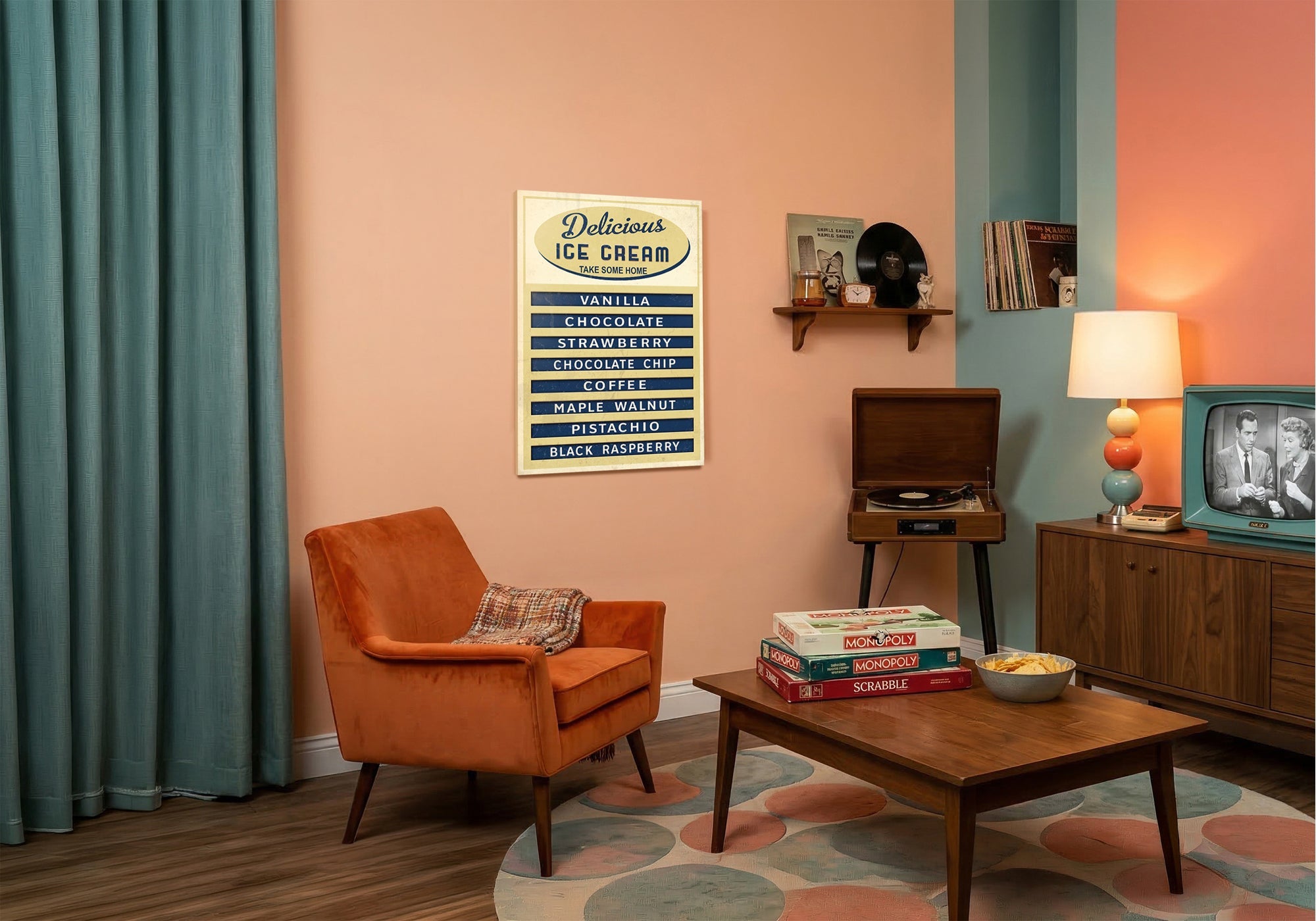
Retro Arcade Wall Art - Nostalgia Done Right
The best retro arcade wall art evokes the feeling of the analog era without cataloguing it. Choose pieces that use the era's color palette, energy, and spirit - not branded collectibles or literal arcade memorabilia. A room with one or two well-chosen retro canvases feels warmer and more intentional than a wall full of nostalgic objects competing for attention.
The analog era had a visual language worth celebrating — saturated palettes, pixel energy, a specific combination of optimism and neon that the technology of the time made possible. The question for a retro arcade room is not how much you love that era. It is whether the room communicates that love through atmosphere or through inventory.
The emotional destination is nostalgic warmth and playful energy. When it works, people walk in and feel something — a kind of looseness, a sense that this is a room where fun is the point. When it doesn't work, they see things. Shelves of figures. Branded signs. Framed posters stacked frame-to-frame. The love is visible but the feeling gets buried under the stuff. Evocation creates a room. Inventory creates a display.
This guide is for the wall art specifically. Everything here is Designed in California and hand-made to order by Fine Art Canvas - making canvas art since 1989, with free 90-day returns and a 1-year warranty on every piece.

Retro Arcade at a Glance
- Emotional destination: Nostalgic warmth, playful energy
- Works best in: Entertainment rooms, game rooms, media rooms with a retro or eclectic aesthetic
- The core decision: Evoke the era through atmosphere, not through branded memorabilia
- What to look for: Bold color palettes from the era, compositional energy, scenes that capture the feeling without requiring the viewer to recognise a specific franchise
- What to avoid: Licensed character art, branded signage, novelty pieces that work as jokes rather than as room-anchors
The Difference Between Evocation and Inventory
The retro arcade era - roughly the late 1970s through the early 1990s - had a genuinely distinctive visual language. Saturated color palettes. Chunky pixel grids. That particular combination of optimism and neon. The typography. The cabinet designs. These were not arbitrary aesthetic choices; they were what the technology of the time made possible, and they produced something that has aged into genuine warmth.
The mistake is assuming that to capture that feeling, you need to display the objects. You don't. What you need is the palette, the energy, and the compositional spirit - applied through art that earns its place on the wall rather than just making a reference.
A canvas that uses the era's color palette and captures the visual energy of an arcade scene makes the room feel a certain way. A framed logo print, a branded sign, or a novelty poster declares that the room owner knows and loves the era. The first creates atmosphere. The second creates a display. Both are expressions of the same passion - only one of them makes the room better to be in.
This is not a rule against specific pieces or subjects - it is a framing question. A scene of arcade cabinets rendered with genuine craft and visual weight belongs on a wall. A cheap print of a game's title screen does not, regardless of how much you love the game. The test is whether the piece makes the room feel the way you want it to feel when guests arrive, or whether it requires them to recognise something to appreciate it.
When Retro Arcade Is the Right Direction
Retro arcade art works best when playfulness is a genuine priority for the room. Not every entertainment room wants this - a room built primarily around serious film viewing or competitive gaming may want a different emotional register. But when the room is about fun, about gathering people who enjoy being in a space that doesn't take itself too seriously, retro arcade art delivers something the other styles in this cluster don't.
✓ Works Well When
- The room has a playful, informal personality - guests feel loose and comfortable, not like they're in a showroom
- You love the visual language of the era more than any specific franchise - you're drawn to the aesthetic, not just the IP
- The room hosts game nights, casual gatherings, or multi-use social events as often as serious viewing sessions
- You want warmth in a room that has a lot of dark or tech-heavy elements - retro palette brings brightness without clashing
- You're balancing a gaming setup and want art that celebrates the culture without pointing directly at the equipment
✗ Consider Something Else If
- The room is built primarily around film and serious cinematic experiences - retro arcade energy is playful where cinema wants quiet and anticipation
- The memorabilia is beginning to become the room rather than support it - when the collection crowds the atmosphere you're trying to create, the walls need to do the opposite: open space, not fill it
- You want contemporary, minimal, or moody - retro warmth reads as cheerful, which can work against a darker atmosphere
- The room already has a lot of branded or licensed objects - adding retro art on top of that will tip from curated into cluttered
Retro arcade and gamer aesthetic are often confused, but they serve different emotional registers. Retro arcade is warm and nostalgic - it celebrates an era. Gamer aesthetic is current and identity-driven - it celebrates who plays now. Both belong in this cluster, but they point in different directions. If you want the room to feel like a love letter to the past, retro arcade. If you want it to feel like a serious setup for current play, see the Gamer Aesthetic guide.
Five Moves That Work
These are the practical decisions that separate a retro arcade room that works from one that looks like it's still being assembled.
1. Lead with one large-format anchor piece
The most common mistake in retro-themed rooms is distributing too much across too many small pieces. One well-chosen canvas - 36 inches wide or larger on a side wall - does more atmospheric work than six smaller pieces arranged in a grid. It also gives the room breathing room rather than turning the wall into a catalogue. Choose a piece with sufficient visual weight to hold the wall and establish the palette. Everything else in the room follows from it.
2. Let the palette do the work
The retro arcade era had a distinctive color sensibility: deep blacks and navies offset by saturated magentas, teals, electric blues, and warm ambers. Pieces that use this palette - even without any specific reference to gaming - carry the period's energy. A canvas in that color family reads as retro without requiring the viewer to identify what's being referenced. This matters for guests who don't share the specific passion - the room should feel good to everyone, not just to people who recognise the source material.
3. Choose composition over recognition
The strongest retro arcade pieces work as visual compositions - they have rhythm, weight, and internal logic that makes them interesting to look at beyond the reference they carry. A painting of arcade cabinets in a strong diagonal composition is more interesting than a flat reproduction of a title screen, even if the latter is from a game you love deeply. Ask whether the piece would work in the room if you'd never heard of the subject. If yes, it belongs on the wall.
4. Place art where it frames, not competes
In rooms with gaming setups, the monitor or TV already has enormous visual presence. Art placed directly adjacent to a screen will lose - the screen wins every time it's active. The stronger placement is side walls and the wall behind the seating, where art frames the experience rather than competing with it. For sizing guidance specific to this room type, see the Wall Art Size Guide.
5. Resist the urge to fill every surface
Retro arcade rooms that feel crowded almost always share the same problem: the walls are doing the collecting work that surfaces and shelves should do. If you have physical collections - cartridges, figures, controllers - display them on shelves. Give the walls one or two pieces that deliver the atmosphere. The restraint is what makes the curated pieces read as choices rather than overflow.
Six Pieces From the Collection
Every piece below is hand-made to order and pulled from the Retro Arcade collection. Each is available as gallery-wrapped canvas, framed canvas, or framed print - pricing live at each product page.


Common Mistakes and the Fix
A wall that has something from every game you've ever loved ends up feeling scattered. The references compete rather than combine. Fix: choose one era, one palette, one mood - and use no more than two or three pieces on any given wall. The restraint is what makes each piece register as a deliberate choice.
A poster of a title screen is an expression of fandom. A canvas print of arcade cabinets rendered with real compositional thinking is wall art. Both hang on a wall - only one of them makes the wall better. Fix: choose pieces you'd want to look at even if you'd never played the game, or knew the reference. Composition, color, and visual weight matter more than the franchise.
Retro arcade is warm and nostalgic. Gamer aesthetic is current and setup-focused. They pull in different emotional directions, and mixing them on the same wall tends to produce neither. Fix: choose one register for the room and commit to it. If you want both, give each its own wall or zone.
Small retro prints on a large wall look tentative - like the start of a collection that hasn't arrived yet. Fix: go larger than you think. A 36-inch or 48-inch canvas on a side wall makes a genuine statement and earns its position in the room. For guidance on sizing to your specific wall, see the Wall Art Size Guide.
Ready to Find Your Piece?
Browse the full Retro Arcade collection - hand-made to order, Designed in California, with free returns on every piece.
Shop Retro Arcade Wall ArtFrequently Asked Questions
What makes retro arcade wall art different from gaming wall art?
Retro arcade art evokes a specific era - roughly the late 1970s to early 1990s - through its color palette, visual language, and compositional energy. Gaming wall art, by contrast, tends to be current and identity-focused, reflecting contemporary gaming culture and setup aesthetics. Retro arcade is warm and nostalgic; gamer aesthetic is energetic and present-tense. Both work in entertainment rooms, but they serve different emotional destinations. If you want warmth and playful nostalgia, retro arcade. If you want immersion and identity for a current setup, see the Gamer Aesthetic guide.
How many retro arcade pieces should I hang in one room?
Fewer than you think. One large-format anchor piece on a side wall - 36 inches wide or larger - does more atmospheric work than four or five smaller pieces competing for attention. If you want a second piece, choose something that extends the palette rather than repeating the subject. The restraint is what makes each piece register as a deliberate choice rather than overflow from a collection.
Should retro arcade art use specific game references or stay generic?
This depends on whether you want the piece to communicate with everyone in the room or only with people who share the specific passion. Art that uses the era's visual language works for everyone and creates atmosphere. Art that requires the viewer to recognise a specific franchise is an expression of fandom that only lands for people who share it. For walls in shared social spaces, era-referencing beats franchise-specific. For a personal game room or dedicated gaming space, specific references can be more meaningful.
What colors work best in retro arcade wall art?
The period's palette - saturated magentas, electric blues, teals, warm ambers, and deep blacks - holds up well and reads as unmistakably retro without requiring a specific reference. These colors also tend to work well against the dark walls common in entertainment rooms, where strong contrast is important for the art to register in low light. Avoid pieces with washed-out or pastel palettes in media rooms - they tend to disappear in dim viewing conditions.
Can retro arcade art work in a room that also has modern gaming equipment?
Yes, and it often works better than current gaming aesthetic art in mixed-use rooms. Retro arcade art celebrates the culture rather than the current setup, which means it doesn't date as quickly when equipment changes. The key is not to mix it with current gaming identity art on the same wall - they pull in different emotional directions. Give each its own zone or commit to one register for the whole room.
What size canvas works in a game room or entertainment room?
Go larger than you'd instinctively choose. In rooms where a screen already commands significant visual attention, small art gets lost. On side walls, aim for at least 36 inches wide; 48 inches or larger on a standard wall makes a genuine statement. For a complete sizing guide including placement rules for entertainment rooms, see the Wall Art Size Guide.
The analog era had a visual language worth celebrating. One well-chosen piece that evokes it does more for the room than a wall full of things that reference it.


Leave a comment
This site is protected by hCaptcha and the hCaptcha Privacy Policy and Terms of Service apply.